
Start with the zone and the cleaning regime
In hygienic machinery, the environment usually sizes the actuator before the load does. A 200 N pusher in a high-care meat hall and a 200 N pusher in a dry bakery packing room are different products. Before force and stroke, establish:
- Zone: product contact, splash zone (product or cleaning fluid can reach it), or non-product zone.
- Cleaning method: dry wipe, low-pressure foam and rinse, high-pressure hot water, clean-in-place, steam.
- Chemicals: alkaline (caustic) detergents, acid descalers, chlorinated or other sanitisers, at what concentration and temperature.
- Frequency: every shift, daily, weekly.
- Product: dry, wet, fatty, salty, acidic; allergens that must be fully removed.
- Standards your customer applies: EHEDG, 3-A, NSF, or a retailer or site code.
The design benchmark for hygienic equipment in Europe is typically EHEDG guidance, with 3-A sanitary standards in the US (CDA). In Europe, machine cleanability also falls under EN 1672-2 and the machinery legislation (Elesa+Ganter).
What IP69K tests, and what it does not
IP69K originated in DIN 40050-9 for road vehicles and is now widely used for food machinery. The test (RST, IP code sheet):
| Parameter | IP69K test condition |
|---|---|
| Water temperature | 80 °C |
| Pressure | about 80–100 bar |
| Flow | 14–16 litres per minute |
| Nozzle distance | 100–150 mm, flat jet |
| Angles | 0°, 30°, 60°, 90° |
| Duration | 30 s per angle, specimen on a turntable at 5 rpm |
Read the rating carefully:
- It is a static test. Tolomatic, for example, rates its RSH and IMA-S stainless actuators “IP69K (static)”. A rod moving through its seal while being sprayed is a harder case.
- It is not an immersion test. IP67 and IP68 cover immersion; ask for both if the actuator may stand in water.
- It does not test chemicals. Seal and coating compatibility with your detergents is a separate question.
- It does not test thermal shock. A warm actuator hit by a cold rinse contracts its internal air, which can pull moisture past seals. Ask how the design handles breathing: sealed and pressure-tight, vented through a protected breather, or purged.
- It applies to the whole assembly as tested. Motor, cable gland, connector and mounting all need to be part of it. Tolomatic’s ERD-SS2, for instance, puts the motor inside a stainless enclosure to keep the IP69K rating; the IMA-S integrates the motor into the actuator (Tolomatic).
Hygienic design principles
EHEDG’s guidelines, and machinery standards such as EN 1672-2, come down to surfaces that can be cleaned and seen to be clean. Practical rules that suppliers publish:
- Smooth surfaces: Elesa+Ganter gives Ra < 0.8 µm as easy to clean (Elesa+Ganter).
- Generous internal radii: preferably 6 mm or more, in the same source.
- No crevices or gaps: seals designed so no gaps occur; hygienically designed O-ring grooves; no steps from misaligned parts.
- Self-draining: interior and exterior areas drainable, with no horizontal ledges or pockets. Rounded edges stop particles pooling (CDA).
- No exposed threads or recessed fasteners in the splash zone where possible; use hygienic fasteners where they cannot be avoided.
- Materials: non-rusting stainless steel; plastics and elastomers compliant with FDA and EU food contact rules.
- Shape: rod-style actuators are inherently easier to seal for washdown than slotted rodless bodies (Manufacturing.net). Integrated motor designs remove a coupling, a second housing and their crevices.
Mounting matters as much as the actuator. A hygienic actuator bolted to a frame with a flat plate, exposed bolts and a gap underneath brings the crevice back.
Stainless grades: 304 vs 316
| 304 | 316 / 316L | |
|---|---|---|
| Composition | chromium-nickel austenitic | as 304 plus 2–3% molybdenum |
| Chloride resistance | can pit where chlorides break down the passive layer | better resistance to chlorides |
| Typical use | dry areas, housings, many food products | washdown, meat, salty and acidic products, marine |
Source: Food Manufacturing. The same article suggests duplex grades for stagnant or slow-moving brine, especially at higher temperatures, and warns that carbon steel contact (tools, sparks from nearby grinding) can cause spot corrosion on stainless.
AISI 300 series is the usual choice for washdown actuators, excluding types 301 and 302, with 304 and 316 the most popular (Manufacturing.net). Aluminium may suit some dry-product areas but not strong caustic cleaners. Tolomatic’s RSH and IMA-S are 316 throughout.
Lubricants: H1, H2, H3
- H1: incidental food contact possible, for example above the product line.
- H2: no possibility of contact, for example below and away from the line.
- H3: edible, water-soluble rust preventives (meat hooks, trolleys).
ISO 21469 sets hygiene requirements for the formulation, manufacture and handling of incidental-contact lubricants (Machinery Lubrication). For actuators in or above a splash zone, specify H1 grease in the screw and bearings and on any rod wiper. Ask about the relubrication interval and how it is done: Tolomatic’s RSH, for example, lists a one-year or 1,000,000-cycle interval through a relubrication port, so the actuator does not need to be opened in the hygienic area.
Gearboxes on hygienic axes need the same thought. Beckhoff’s AG2800 hygienic planetary uses NSF H1 lubrication and smooth, electro-polished, dead-space-free surfaces (Beckhoff).
Cleaning chemicals and seals
Washdown actuators must survive frequent cleaning with water, detergents, steam, caustic soda, citric acid and other sanitary cleaning solutions (Manufacturing.net). Points to cover with the supplier:
- Alkaline detergents attack some elastomers and aluminium.
- Acid cleaners and descalers attack some coatings and plain steels.
- Chlorinated sanitisers (hypochlorite) can damage the passive layer on stainless; keep contact minimal and rinse thoroughly (Food Manufacturing).
- Seals: polyurethane suits most applications and tolerates abrasives such as salt and sugar; for the most aggressive caustic chemicals the CDA article recommends polyurethane with UHMWPE (CDA). Viton and UHMW polyethylene are common food-safe choices (Manufacturing.net).
Give the supplier the product name or safety data sheet of each chemical, its use concentration, temperature and contact time. A general “chemically resistant” claim is not enough.
Worked example: portion pusher in a high-care area
Requirement. A pusher transfers portions of cooked meat from a conveyor to a tray line. Pusher head and arm 8 kg; portion 6 kg; friction coefficient on the stainless deck about 0.4 (assumed). Stroke 300 mm in 0.8 s (0.2 s accelerate, 0.4 s constant, 0.2 s decelerate), return the same, 30 cycles per minute. Splash zone above exposed product. Daily clean: alkaline foam, rinse with hot water from a pressure washer, chlorinated sanitiser.
Environment first.
- Splash zone above product: H1 lubricant, 316 stainless, hygienic shape.
- Hot pressure washer: IP69K on the complete assembly, including the motor or its enclosure and the cable entry.
- Chlorinated sanitiser and salty product: 316, not 304; seals confirmed against the specific products.
Thrust. Peak speed = 0.3 / (0.8 − 0.2) = 0.5 m/s; acceleration = 2.5 m/s².
- Inertial force: 14 × 2.5 = 35 N
- Friction: 0.4 × 6 × 9.81 ≈ 24 N
- Rod seal and wiper drag: assume 50 N for illustration (ask the supplier; hygienic seals grip harder than standard ones)
- Peak thrust ≈ 110 N
That is a small fraction of what any hygienic rod actuator can deliver. The force calculation sets nothing here except the motor; the environment sets the actuator.
Speed and duty. 0.5 m/s is within published maxima for the ERD (1,016 mm/s) and RSH (500 mm/s, at the limit). At 30 cycles a minute with dwell, duty is moderate; check the motor’s RMS torque.
Side load and rotation. The pusher head is 200 mm wide and the portion may catch one side. A plain rod is not a guide. Use the actuator’s internal anti-rotate option (offered on ERD15/20 and RSH) and carry side load on a separate hygienic guide, or choose an actuator rated for the side load at full extension.
Result. A stainless rod actuator in the ERD-SS2 configuration (all-stainless body, motor in a stainless IP69K enclosure, food-grade grease) is the economical fit. If the customer’s audit expects heavier construction or a higher force later, the 316 RSH covers it. An IMA-S integrated stainless servo actuator removes the separate motor enclosure and is worth pricing for the reduced crevice count.
Products in our range to consider
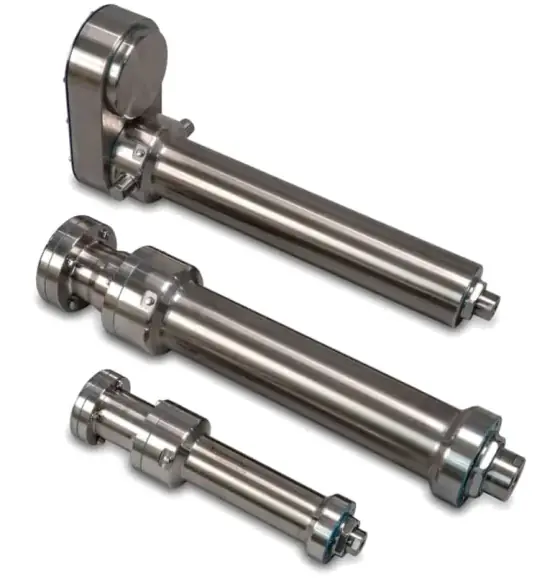
- Tolomatic RSH: all-316 stainless hygienic rod actuator, IP69K (static), ball or roller screw, up to 35,330 N.
- Tolomatic IMA-S / IMA-ST: 316 stainless integrated servo actuator, IP69K (static), FDA gaskets and EHEDG cord grips, up to 11,120 N.
- Tolomatic ERD: stainless-tube rod actuator; SS1/SS2 options give an all-stainless IP69K washdown build, food-grade grease option.
- Tolomatic IMA: integrated servo rod actuator in white food-grade finish, IP65 standard and IP67 option, for non-washdown food areas.
- LA stainless steel in-line actuator: 316 stainless, IP67M 12/24 VDC in-line actuator for hatches, doors and windows on vessels, up to 2,300 N.
- Apex AE / AER / AES / AESR: planetary gearboxes with all-stainless AES/AESR versions and food-grade grease.
- Leadshine CS-M: closed-loop steppers with IP65 (WP) versions, for splash-protected small axes.
What else the build needs
- Motor: an IP69K stainless servo, an integrated actuator, or a standard motor in a stainless enclosure. See servo and stepper motors.
- Gearbox with food-grade grease and a suitable rating: see how to select a planetary gearbox.
- Drive in the cabinet, away from the washdown area, with hygienic cable glands at the machine: see servo drives.
- Cables with food-compatible, chemical-resistant jackets and hygienic glands or connectors.
- Position sensing: IP67/IP69K switches or the motor’s own feedback, not exposed reed switches in slots.
- Guides of hygienic design for side loads.
- Controller and HMI with suitable front ratings: see how to select an HMI and remote I/O.
- For thrust and life sizing, see how to size a linear actuator and the packaging and food market page.
Things that catch engineers out
- Specifying force before environment. The washdown regime chooses the product family.
- Treating IP69K as complete washdown approval. It is static, short and chemical-free.
- Rating the actuator but not the motor, gland and connector. The weakest part sets the assembly’s rating.
- 304 in chlorinated washdown. Pitting follows; use 316.
- “Food grade” grease that is not H1 in a splash zone.
- Thermal shock drawing water in. Ask how the design breathes.
- Mounting that creates crevices. Stand-offs and hygienic fasteners matter.
- “Designed to EHEDG guidelines” read as certified. Ask for a certificate if one is required.
- Relubrication that needs disassembly in the hygienic area.
Checklist
Send these to our engineers, or enter them in the spec builder:
- Zone: product contact, splash or non-product
- Cleaning method, pressure, water temperature and frequency
- Chemicals: names or data sheets, concentrations, temperatures, contact times
- Product type: wet, fatty, salty, acidic, allergens
- Standards your customer requires (EHEDG, 3-A, NSF, site codes) and whether certification is needed
- Material: 304 or 316, surface finish requirement
- Required IP ratings (IP69K, IP67) for the full assembly, including motor and connectors
- Lubricant category (H1) and acceptable relubrication method
- Force, stroke, speed, cycle rate, orientation, side loads
- Ambient temperature range, including cold rooms
- Motor and drive arrangement, cable length to the cabinet
For the wider family, see our linear actuators overview.
Frequently asked questions
What does IP69K actually test?
Resistance to close-range, high-pressure, high-temperature water jets. The test sprays 80 °C water at about 80–100 bar and 14–16 litres per minute from 100–150 mm, at 0°, 30°, 60° and 90°, for 30 seconds per angle, with the specimen on a turntable. It does not test immersion, cleaning chemicals, thermal shock or a moving rod, so it is necessary but not sufficient for washdown.
Is IP69K better than IP67?
They test different things. IP67 covers temporary immersion; IP69K covers hot, high-pressure jets. A product can pass one and fail the other, which is why washdown equipment is often marked with both. If the actuator is hosed down at close range with hot water, ask for IP69K; if it may sit in standing water, ask for IP67 or IP68 as well.
Should I use 304 or 316 stainless steel in food processing?
316 for washdown, salty or acidic products and chlorinated cleaners. 316 adds 2–3% molybdenum to a 304-type composition, which improves resistance to chloride pitting. 304 is fine for many dry areas and housings. Hypochlorite (bleach) sanitisers can damage the passive layer on both grades, so keep contact short and rinse thoroughly, and use duplex grades for stagnant brine at temperature.
What is an NSF H1 lubricant?
A lubricant registered for use where incidental contact with food may occur, such as on equipment above a product line. H2 lubricants are for locations with no possibility of food contact, and H3 are edible, water-soluble rust preventives. ISO 21469 adds hygiene requirements for how incidental-contact lubricants are formulated, made and handled. 'Food grade' does not mean the lubricant may be in contact with food.
Is an actuator 'designed to EHEDG guidelines' EHEDG certified?
Not necessarily. EHEDG publishes hygienic design guidelines and runs a separate certification scheme for equipment. Many manufacturers state that a product is designed to EHEDG, 3-A or NSF guidelines; that is a design claim, not a certificate. If your customer or auditor requires certification, ask for the certificate and the exact model and configuration it covers.
Sources
- RST: Schutzarten durch Gehäuse (IP code), including IP69K test conditions
- Elesa+Ganter: Hygienic design, requirements and design principles
- Food Manufacturing: Stainless steel in food manufacturing, grade selection and care
- Machinery Lubrication: What you should know about food-grade lubricants
- Manufacturing.net: Evaluating actuators for washdown in food applications, part 1
- Controls Drives Automation: Optimising hygienic actuator design
- Tolomatic: Stainless steel electric linear actuators
- Beckhoff: AG2800 planetary gear units for AM8800 stainless steel servomotors
Figures are summarised from the sources above and from manufacturers' published data on the date shown. Always confirm against the current datasheet for your exact part.