
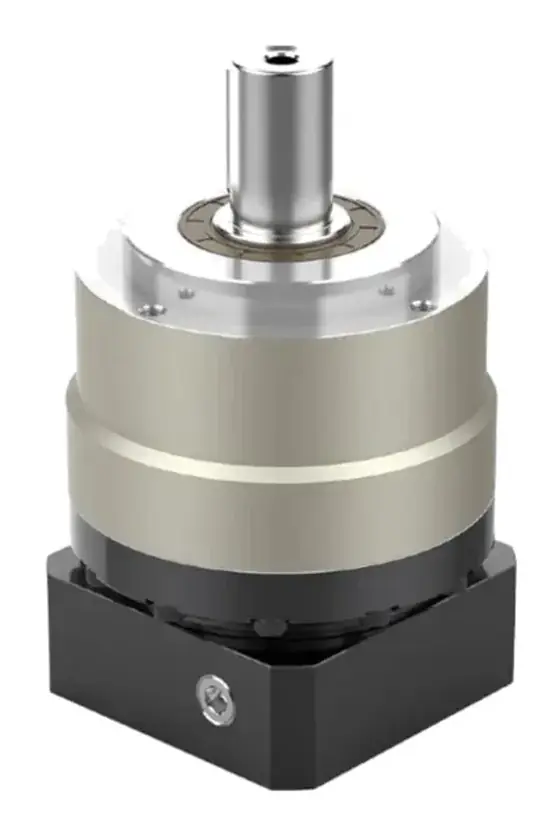
In short:Decide precision or economy from the position tolerance at the load, inline or right angle from the envelope, and stainless only where the gearbox is washed down; then set the ratio from speed and inertia and size the frame so cube-mean torque sits under T2N, peak cyclic torque under T2B with the maker's operating factor, crash torque under T2NOT, and the real shaft load under the radial rating at its actual position.
Why planetary, and the order to decide in
A planetary gearbox shares the load across several planet gears, so it packs a lot of torque into a short, coaxial housing. Machine Design notes that a planetary set has at least three meshes carrying the load, which is where its stiffness and torque density come from, and that planetary designs can take input speeds above 6,000 rpm (Machine Design). That makes it the default reducer for servo and stepper axes below about 100:1.
For the general sizing method and other gearbox types, see how to select a gearbox and strain-wave vs planetary vs cycloidal.
Make the decisions in this order:
- Grade: precision or economy, from the position tolerance.
- Geometry: inline or right angle, solid shaft, flange or hollow output.
- Material and sealing: standard, stainless, food-grade grease, IP rating.
- Ratio: from motor speed, output speed and inertia.
- Torque: T2N, T2B and T2NOT against your cycle.
- Shaft loads: radial and axial at the actual point of application.
- Motor adaptor: flange, shaft, clamp.
Precision vs economy planetary: what you actually pay for
The difference is mainly backlash, torsional stiffness, bearing capacity and sometimes noise. Both kinds use the same basic gear train.
| Precision (servo) planetary | Economy planetary | |
|---|---|---|
| Backlash, one stage | about 1–5 arcmin by class (Wanshsin WSH: P0 ≤1.5, P1 ≤3, P2 ≤5) | about 8 arcmin and up (Apex P-II classes run from ≤8 one stage to ≤12 three stage) |
| Gearing | usually helical, ground | spur or helical |
| Output bearing | large preloaded bearings for radial and tilting loads | lighter |
| Typical use | rack and pinion, gantries, rotary tables, robot axes | conveyors, belt transfers, feeders, AGV wheels where position is measured elsewhere |
How to choose. Convert the tolerance at the load into an angle at the gearbox output:
θ (arcmin) = (x / r) × 3,438
where x is the allowable position error and r is the pinion or pulley radius (1 rad = 3,438 arcmin). If the axis always stops against gravity or a constant drag, the backlash is taken up in one direction and matters less than stiffness. If it reverses torque at the stopping point (a horizontal axis decelerating to a stop, an indexing table), backlash and wind-up both land in your tolerance. Budget them together with the rack, belt and coupling.
If the result is several times larger than an economy class, buy economy and spend the money elsewhere. If it is close to a precision class, go one class tighter or put a linear encoder on the load.
Inline vs right-angle planetary
A right-angle planetary adds a spiral bevel input stage ahead of the planetary stages. It solves envelope problems: a motor that would otherwise stick out past the guarding, or an axis that must fold back along a frame.
The costs show in catalogues:
- Efficiency: Wanshsin’s WSH inline quotes ≥97% for one stage and ≥95% for two; the right-angle WSHR quotes ≥95% and ≥92%. Apex’s AER right-angle family quotes ≥95% and ≥92%.
- Backlash: WSHR starts at P1 ≤4 arcmin for one stage (there is no P0 class), against ≤1.5 arcmin for the best inline WSH.
- Torque: the right-angle version of a frame is often rated lower; WSHR tops out at 1,400 Nm rated against 2,400 Nm for WSH.
Use inline wherever it fits.
Stainless and washdown planetaries
Standard planetaries are typically aluminium or steel housings with painted or plated finishes, rated around IP65 at the output. In food, pharmaceutical and marine areas, three things change:
- Material: an all-stainless body and output shaft. Apex’s AES and AESR are the all-stainless inline and right-angle versions of the AE/AER family.
- Lubricant: food-grade grease. Apex specifies food-grade grease for AES/AESR. Beckhoff’s AG2800 hygienic planetary, built for its stainless servomotors, uses NSF H1 lubrication (Beckhoff).
- Ingress rating and shape: a stainless gearbox is not automatically washdown-proof. Apex lists IP65 for the AE family (Apex). Fully hygienic units go further: Beckhoff lists IP69K for the AG2800 combined with the motor, plus electro-polished, dead-space-free surfaces and a round motor adaptor.
Tell the supplier how the machine is cleaned (dry wipe, low-pressure foam, high-pressure hot jet), which chemicals are used and how close the gearbox is to exposed product. Our guide to hygienic washdown actuators and IP69K covers ratings, grades and lubricants in more depth.
Ratio: speed first, then inertia
i = n_motor / n_output
Pick n_motor near, not at, the motor’s rated speed so the drive keeps voltage headroom. Then check reflected inertia:
J_reflected = J_load / i²
Servo sizing guidance commonly targets a load-to-motor inertia ratio of 10:1 or less, tighter for very dynamic axes (Motion Control Tips; Stöber via CDA).
One stage covers about 3:1 to 10:1; above that you need two stages (to about 100:1), adding length, cost and backlash (WSH two-stage classes are P0 ≤3, P1 ≤5, P2 ≤8 arcmin). Catalogue ratios are fixed steps, so trim the final speed with the pulley or pinion size rather than a special gear.
T2N, T2B and T2NOT: sizing the frame
Catalogues give three output torques. Compare each with a different number from your cycle.
| Your number | Compare with | What the catalogue says |
|---|---|---|
| Cube-mean torque over the cycle | T2N, nominal output torque | sets life; Machine Design: rated continuous torque must be ≥ the calculated equivalent load torque |
| Peak cyclic torque × operating factor | T2B, maximum cyclic (acceleration) torque | Apex sets T2B at 60% of T2NOT |
| Crash, jam or E-stop torque | T2NOT, emergency-stop torque | WITTENSTEIN alpha: no more than 1,000 times in the life, never exceeded |
Sources: Apex; WITTENSTEIN alpha; Machine Design.
The cube-mean, weighted by speed and time, is:
T_m = ( Σ nᵢ tᵢ |Tᵢ|³ / Σ nᵢ tᵢ )^(1/3)
The cube reflects bearing and gear life laws; it is not the RMS used for motor heating.
Operating factor. Peak torque is multiplied by a factor that rises with cycles per hour and shock. Each maker publishes its own method: WITTENSTEIN alpha’s operating mode factor, for example, takes values from 1.0 to 3.0 depending on duty, cycle count and dynamics. Use the method of the gearbox you are buying; mixing one maker’s factors with another’s ratings gives meaningless margins.
Limit the motor. A servo’s peak torque × ratio × efficiency can exceed T2NOT on smaller frames. Set the drive torque limit so it cannot.
Input speed and heat
Compare the mean input speed over the cycle with the nominal input speed, and the peak with the maximum input speed. WITTENSTEIN alpha limits nominal speed by a 90 °C housing temperature at 20 °C ambient (WITTENSTEIN alpha), so continuously running axes are often heat-limited.
Radial and axial loads on the output
Pulleys and pinions load the output bearing. Two rules:
- Use the load at its real position. Apex rates radial and axial load at the centre of the output shaft at 100 rpm and applies a position factor elsewhere (Apex). WITTENSTEIN alpha refers its radial force to the shaft centre at 150 rpm.
- Include the forces that are not torque. Belt pretension (often larger than the working pull), gear separating force (about 0.36 × tangential force for a 20° pressure angle) and any overhung weight.
Helical gears also create an axial component, which the Stöber guidance flags as an extra load to check (CDA). If the loads are beyond the output bearing, support the pulley shaft on its own bearings and couple the gearbox through a flexible element.
The motor adaptor
Servo planetaries come with an adaptor plate and input clamp for a named motor, so send the motor model or its flange pilot, bolt circle, shaft diameter, length and key. WITTENSTEIN alpha bushes smaller shafts with a sleeve of at least 1 mm wall; Stöber lists short shaft engagement as a cause of input slip (CDA); and Machine Design stresses tightening the clamp to the maker’s torque so the shaft cannot slip in the sun gear bore.
Worked example: right-angle planetary for a washdown belt transfer
Requirement. An indexing belt transfer in a food packaging line. Moving mass (trays, product and belt) 40 kg. Drive pulley pitch diameter 95.5 mm, so 300 mm per revolution and r = 47.75 mm. Index 600 mm in 0.6 s (0.2 s accelerate, 0.2 s constant, 0.2 s decelerate) then dwell 0.4 s: a 1.0 s cycle, 3,600 indexes per hour. Friction 60 N. Position tolerance at the tray ±0.5 mm. The motor must fold back along the frame. Daily low-pressure foam clean. A 3,000 rpm servo with an assumed rotor inertia of 1.5 kg·cm² (use your motor’s datasheet value).
Speed. Peak speed = 0.6 / 0.4 = 1.5 m/s, acceleration = 1.5 / 0.2 = 7.5 m/s². Output speed = 1.5 / 0.3 = 5 rev/s = 300 rpm. At 3,000 rpm motor speed, i = 3,000 / 300 = 10:1.
Inertia. J_load = m r² = 40 × 0.04775² = 0.0912 kg·m². Reflected: 0.0912 / 10² = 9.1 kg·cm², an inertia ratio of about 6:1. Inside the 10:1 target.
Torque cycle at the gearbox output.
- Accelerate (0.2 s, mean 150 rpm): F = 40 × 7.5 + 60 = 360 N, T = 360 × 0.04775 = 17.2 Nm
- Constant (0.2 s, 300 rpm): 60 N, 2.9 Nm
- Decelerate (0.2 s, mean 150 rpm): 300 − 60 = 240 N, 11.5 Nm (reversed)
- Dwell (0.4 s): 0 Nm
Cube-mean torque. Σ n t T³ = 150×0.2×17.2³ + 300×0.2×2.9³ + 150×0.2×11.5³ ≈ 152,400 + 1,400 + 45,200 = 199,000; Σ n t = 120. T_m = (1,658)^(1/3) ≈ 11.8 Nm. This must be below T2N.
Peak and operating factor. At 3,600 cycles per hour the maker’s operating factor will be above 1. If, for illustration, that catalogue’s factor were 1.3, T2B must exceed 17.2 × 1.3 ≈ 22.4 Nm.
Crash torque. If the motor peak is 3.8 Nm (assumed), 3.8 × 10 × 0.95 ≈ 36 Nm could reach the output in a jam. Pick a frame with T2NOT above that, or set the drive torque limit lower.
Mean input speed. The pulley turns 2 revolutions per 1 s cycle, 120 rpm average; the input averages 1,200 rpm. Check against the nominal input speed.
Radial load. The belt supplier’s recommended pretension is, say, 400 N per strand, so the shaft sees about 800 N with the pulley centre 40 mm from the output flange. Check the radial rating with the position factor for 40 mm, not the headline figure.
Backlash. θ = (0.5 / 47.75) × 3,438 ≈ 36 arcmin. An economy class (8–12 arcmin) is comfortably inside it once belt stretch is allowed for. Precision would be wasted money here.
Selection. A right-angle stainless planetary at 10:1 in standard backlash, food-grade grease, smallest frame with T2N above 11.8 Nm, T2B above about 22 Nm after the factor, T2NOT above 36 Nm and a radial rating above 800 N at 40 mm. The Apex AESR fits that brief. Its catalogue rating is IP65: fine for foam cleaning, but if the line moves to high-pressure hot-water jets, shield the gearbox or move to an IP69K hygienic gear unit.
Products in our range to consider
- Wanshsin WSH: high-rigidity inline planetary, backlash classes P0 ≤1.5, P1 ≤3, P2 ≤5 arcmin one stage, up to 2,400 Nm rated.
- Wanshsin WSHR: right-angle WSH with a spiral bevel stage, ratios 3:1 to 200:1, ≥95% efficiency one stage.
- Wanshsin WTH: inline planetary built for high radial loads, up to 2,050 Nm rated.
- Wanshsin WTHR: right-angle version of the WTH, ratios 4:1 to 200:1.
- Wanshsin WAE: high-precision round-flange planetary for input speeds to 10,000 rpm, ≤2 arcmin one stage.
- Apex AE / AER / AES / AESR: helical planetary inline and right angle; AES/AESR are all-stainless with food-grade grease.
- Apex AD / ADR / ADS: short high-precision helical planetary with accuracy quoted at under 1 arcmin.
- Apex P-II / P-IIR: economy planetary family, ratios 3:1 to 1,000:1, up to 459 Nm rated.
- Wanshsin WPL / WPF: economy spur-gear planetary in round or square flange, ratios 3:1 to 100:1.
- Apex GL / GLS: AGV planetary with a rotating housing for direct wheel mounting, radial load to 7,200 N.
What else the build needs
- Motor: servo or stepper, sized together with the ratio. See servo and stepper motors, how to select a servo motor and servo vs stepper.
- Drive with a torque limit set to protect T2NOT. See servo drives and how to select a servo drive.
- Feedback: motor encoder for commutation, plus a load-side encoder if backlash must be taken out of the loop. See encoders.
- Brake on vertical or back-driven axes, ideally motor-side where torque is lowest.
- Pulleys, pinions and couplings rated for output torque, with shaft loads checked at their real position.
- Controller for multi-axis coordination: see motion controllers.
- For a complete linear axis instead of gearbox plus belt or rack, see how to size a linear actuator.
Things that catch engineers out
- Paying for precision the axis cannot use. Work out the arcmin allowance first; a belt conveyor rarely needs better than economy.
- Assuming stainless means IP69K. Material and ingress rating are separate specifications.
- Using another maker’s operating factor. T2B margins only mean something with the factor method of that catalogue.
- Ignoring the right-angle penalty. Lower efficiency, higher backlash and sometimes a lower torque rating for the same frame.
- Belt pretension on the output shaft. It is present all the time, even at standstill, and is often the largest radial load.
- Motor shaft too short or keyed into a clamp. Slip and fretting follow. Confirm shaft details before ordering.
Checklist
Send these to our engineers, or enter them in the spec builder:
- Inline or right angle, solid shaft, flange or hollow output, envelope limits
- Position tolerance at the load and the radius it applies at (so we can set the backlash class)
- Motor make and model, or flange, shaft diameter, length and key
- Required output speed and preferred motor speed
- Load inertia at the gearbox output
- Torque cycle: values, speeds and durations of each segment; cycles per hour
- Crash or E-stop torque and the drive’s torque limit
- Radial and axial loads, belt pretension, and their distance from the output flange
- Mounting orientation
- Environment: ambient temperature, cleaning method and chemicals, required IP rating, food-grade lubricant
- Required life in hours
For the wider family, see our gearboxes overview.
Frequently asked questions
When do I need a precision planetary rather than an economy one?
When the gearbox sits inside the position loop and the axis reverses torque near its stopping point. Convert the load tolerance into an angle at the gearbox output and compare it with the backlash class. Economy planetaries are typically around 8 to 12 arcmin; precision ranges go down to 3 arcmin or below. A conveyor or belt transfer with a ±0.5 mm tolerance on a 48 mm pulley radius allows about 36 arcmin, so economy is usually fine.
What is the difference between T2N, T2B and T2NOT?
T2N is the nominal output torque the gearbox can carry continuously for its rated life; compare it with your cube-mean torque. T2B is the maximum torque allowed in normal cyclic operation, such as acceleration peaks, after applying the maker's operating factor. T2NOT is the emergency-stop torque, an occasional overload. WITTENSTEIN alpha limits it to 1,000 occurrences in the gearhead's life; Apex sets T2B at 60% of T2NOT.
Is a right-angle planetary less efficient than an inline one?
Slightly. The spiral bevel stage adds a mesh and its own losses. Published examples: Wanshsin's inline WSH quotes at least 97% for one stage and 95% for two, while its right-angle WSHR quotes at least 95% and 92%. Right-angle versions also usually start at a higher backlash class. Use them when the motor must fold back alongside the machine, not by default.
Can a stainless planetary gearbox be pressure washed?
Only if its rating says so. Stainless housings and food-grade grease resist corrosion and cleaning chemicals, but the ingress rating decides whether a jet can be aimed at it. Apex lists IP65 for its AE/AES family, which is jet-proof at IEC 60529 levels, not IP69K. Hygienic servo gear units rated IP69K and lubricated with NSF H1 grease do exist; specify the cleaning method alongside the material.
Where does the catalogue radial load rating apply?
At a defined point on the output shaft, usually its midpoint, at a stated output speed. Apex rates radial and axial load at the centre of the output shaft at 100 rpm and gives a position factor for other points. WITTENSTEIN alpha refers its radial force to the shaft centre at 150 rpm. If your pulley or pinion sits further out, the allowable load falls.
Sources
- WITTENSTEIN alpha: alpha Value Line NP catalogue (US), glossary and sizing
- Apex Dynamics: AE/AER series catalogue (ManualMachine copy)
- Machine Design: The essentials of sizing and applying planetary servo gears
- Controls Drives Automation: Stöber gearbox sizing to the load
- Beckhoff: AG2800 planetary gear units for AM8800 stainless steel servomotors
- Motion Control Tips: How do I determine what gear ratio I need for my servo system?
Figures are summarised from the sources above and from manufacturers' published data on the date shown. Always confirm against the current datasheet for your exact part.