
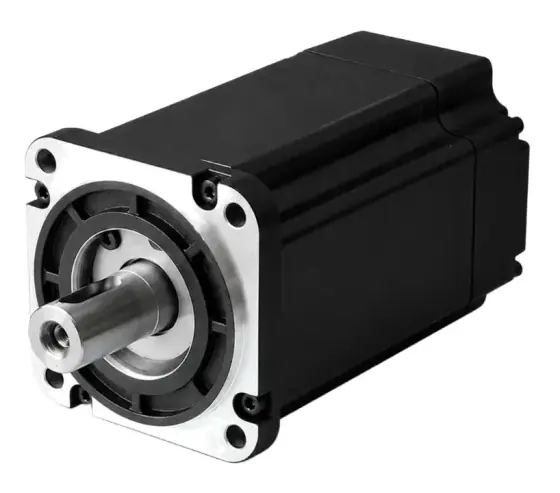
In short:A closed-loop stepper adds an encoder to a hybrid stepper so the drive can detect and correct lost steps, raise current only when the load needs it and alarm on a stall; it lets you size with less torque margin than open loop and run cooler, but a servo still wins at high speed, high torque at speed and with rapidly changing loads.
Why closed loop at all
A hybrid stepper is cheap, simple and has a lot of torque at low speed. Its weakness is that open-loop operation is blind: the controller sends pulses and assumes the shaft followed. If the load torque exceeds what the motor can produce at that speed, it stalls or skips steps and the position error goes undetected. Motion Control Tips notes that the usual defence is to oversize the motor for a large torque margin over the worst case (Motion Control Tips). Leadshine puts that reserve at 40–50% of torque for open-loop systems (Leadshine).
A closed-loop stepper adds an encoder so the drive knows where the shaft actually is. That changes three things: lost steps are corrected or flagged, current can follow the load instead of sitting at maximum, and the torque reserve can shrink.
How closed-loop steppers work
Motion Control Tips describes three approaches, which correspond to what you will find in drive catalogues (Motion Control Tips):
- Position verification. The drive or controller compares commanded and encoder position after a move and makes a correction move if they differ. Simple, but the error is only found after the fact.
- Real-time correction. The encoder is monitored during the move, and the drive compensates by changing the pulse rate, temporarily raising current or adjusting the step angle.
- Servo-style control. The drive uses the encoder to commutate the motor and sets current to match the torque the load needs to move or hold. The stepper then behaves like a high-pole-count servo motor, with lower noise and resonance than open loop.
Many current closed-loop drives work in the third way, closing position and current loops around the motor; Leadshine, for example, describes its CS drives as comparing commanded and actual shaft position and correcting errors in real time. The controller still sends pulse and direction, or a fieldbus target, exactly as for an open-loop drive. That makes closed-loop steppers a drop-in upgrade for many existing designs.
The practical effects reported by makers:
- No undetected step loss: Leadshine says the closed loop eliminates step loss to ensure position accuracy.
- Less heat: Leadshine claims up to 30% lower motor heating at the same working condition.
- More usable torque: Applied Motion Products says peak torque can reach 50% above the open-loop holding torque rating (Control Engineering).
- Lower power and noise: the same source says up to one third of the power and up to 10 dB lower audible noise.
These are manufacturer figures; the gain in your machine depends on how lightly the motor is loaded for most of the cycle.
Open loop vs closed loop vs servo
| Open-loop stepper | Closed-loop stepper | AC or DC servo | |
|---|---|---|---|
| Feedback | none | shaft encoder, typically 4,000–20,000 counts/rev | high-resolution encoder, often 17–23 bit |
| Poles and phases | 50–100 poles, two phases (or three or five phase variants) | as open-loop stepper | 4–12 poles, three phases |
| Current | constant, whatever the load | follows load | follows load |
| Lost steps | undetected | corrected or alarmed | not applicable: position loop |
| Torque at low speed | high | high | depends on motor size |
| Torque at high speed | falls steeply | falls steeply, somewhat better than open loop | maintained to rated speed |
| Tuning | none | little or none; often auto-tune at power-up | needs tuning for each load |
| Hold at standstill | fixed current, stiff | loop-controlled | loop-controlled |
| Cost | lowest | moderate | highest |
Pole and phase counts from Motion Control Tips.
The key limit is speed. Because a stepper has many poles, its electrical frequency rises quickly with shaft speed, and the winding inductance limits current at high speed. Encoder feedback does not change the physics. Motion Control Tips says servos outperform even closed-loop steppers at high speed, at high torque while running fast, and with changing loads. Leadshine claims about 40% better high-speed performance than its open-loop systems. Read the torque-speed curve at your top speed and supply voltage; for a deeper comparison see servo vs stepper.
Encoder resolution: what it buys you
A standard 1.8° hybrid stepper makes 200 full steps per revolution.
| Encoder | Counts per rev | Degrees per count | Counts per full step |
|---|---|---|---|
| 1,000-line incremental | 4,000 | 0.09° | 20 |
| 14-bit magnetic | 16,384 | about 0.022° | about 82 |
| 5,000-line incremental | 20,000 | 0.018° | 100 |
Leadshine’s CS-M motors use 1,000-line (4,000 counts) or 5,000-line (20,000 counts) encoders; its integrated iCS uses a 14-bit magnetic encoder.
What higher resolution does:
- Smoother low-speed motion and better correction, because the drive sees smaller errors sooner.
- Finer position reporting to the controller.
What it does not do: change the motor’s mechanical accuracy. Leadshine quotes ±0.09° position accuracy for CS-M motors. Microstepping, likewise, improves resolution, not accuracy; see how to select a stepper motor.
For a linear axis, convert counts to distance: a belt pulley at 60 mm per revolution with 4,000 counts gives 15 µm per count; a 5 mm lead screw gives 1.25 µm per count.
Stall detection and following error
The drive continuously compares commanded and actual position. The difference is the following error. Set two things:
- The following error limit. If the error exceeds it, the drive alarms and can disable the output. Leadshine’s CS drives indicate following-error faults on the alarm LED and output, and the enable input clears the fault (Leadshine).
- What the controller does with the alarm. Wire the alarm output to the PLC or use the fieldbus status, and decide whether a stall stops the machine, retries or flags the part.
Set the limit tight enough to catch a jam within the tolerance of the process, but loose enough that normal lag during hard acceleration does not trip it. Stall detection is not a safety function; it does not replace guards, STO or a torque-limited safe stop.
Worked example: belt-driven pick axis, open loop vs closed loop
Requirement. Horizontal belt axis. Moving mass 3 kg, friction 10 N. Pulley travel 60 mm per revolution (r = 9.55 mm). Move 300 mm in 0.5 s: 0.1 s accelerate, 0.3 s constant, 0.1 s decelerate. Position tolerance ±0.1 mm. Missing a pick by a stall must be detected. NEMA 23 frame preferred; 48 VDC supply. Motor rotor inertia assumed at 0.28 kg·cm² for this example.
Speed. v = 0.3 / (0.5 − 0.1) = 0.75 m/s; pulley speed = 0.75 / 0.06 = 12.5 rev/s = 750 rpm. a = 0.75 / 0.1 = 7.5 m/s².
Torque.
- Load: (3 × 7.5 + 10) × 0.00955 ≈ 0.31 Nm
- Rotor acceleration: angular acceleration = 7.5 / 0.00955 ≈ 785 rad/s²; 0.28 × 10⁻⁴ × 785 ≈ 0.02 Nm
- Required at 750 rpm: ≈ 0.33 Nm
Open-loop sizing. With the 40–50% reserve Leadshine says open-loop designs carry, the motor needs about 0.33 / 0.5 ≈ 0.66 Nm of pull-out torque at 750 rpm on the chosen drive and supply. Stepper torque at 750 rpm is typically a fraction of holding torque, so read the curve; this often pushes the design to a long-stack NEMA 23.
Closed-loop sizing. With step loss corrected and stalls alarmed, a smaller reserve is reasonable; for illustration, use a 30% margin: 0.33 × 1.3 ≈ 0.43 Nm at 750 rpm. That may allow a shorter motor, with lower inertia, cost and heat.
Resolution check. 4,000 counts per revolution over 60 mm is 15 µm per count, comfortably finer than ±0.1 mm. A 1,000-line encoder is enough.
Stall detection. Set the following-error limit at, say, 1 mm (about 67 counts). A jam is flagged within a fraction of a millimetre beyond normal lag, and the PLC can reject the pick.
Result. A closed-loop NEMA 23 stepper on a pulse or EtherCAT closed-loop drive. If the axis later needs 2 m/s, the stepper’s falling torque at 2,000 rpm becomes the constraint and a low-voltage servo is the better answer.
Products in our range to consider
- Leadshine CS-M: 2-phase closed-loop steppers, NEMA 8 to 34, 0.03–12 Nm holding, 1,000- or 5,000-line encoders, IP65 versions.
- Leadshine ES2-MH: 3-phase high-voltage closed-loop steppers for 220 VAC drives, 8–20 Nm.
- Leadshine CS-D: pulse and direction closed-loop drives for CS-M motors, up to 8 A and 110 VDC.
- Leadshine CS1: enhanced closed-loop drives with 500 kHz pulse input and encoder outputs.
- Leadshine CS3E: single-axis EtherCAT closed-loop stepper drive, CiA402, up to 8 A.
- Leadshine CS2RS: Modbus RTU closed-loop drive with a 16-segment position table, up to 31 axes per network.
- Leadshine 2CS3E: dual-axis EtherCAT closed-loop drive with optional STO.
- Leadshine iCS: integrated closed-loop stepper with 14-bit magnetic encoder and drive, NEMA 17–24, up to 3.5 Nm.
- Leadshine iCS-RS: integrated closed-loop stepper with controller, networked over Modbus RTU.
- Novanta IMS Liberty MDrive: integrated stepper with hMT closed-loop technology, NEMA 17/23/34, multi-protocol Ethernet options.
What else the build needs
- Drive matched to the motor and its encoder (closed-loop motors and drives are usually a matched pair): see how to select a stepper drive.
- Power supply at the voltage the torque curve was read at.
- Controller that uses the alarm or fieldbus status: see motion controllers.
- Gearbox if inertia or torque needs it: see how to select a planetary gearbox.
- Brake on vertical axes; closed loop does not hold a load without power.
- Encoder and motor cables of the specified length and shielding.
- Compare with integrated servo motors and the servo and stepper motors hub.
Things that catch engineers out
- Expecting servo performance at speed. Closed loop does not flatten a stepper’s torque-speed curve.
- Reading the torque curve at the wrong voltage. High-speed torque depends on supply voltage and drive.
- Treating encoder counts as accuracy. Motor accuracy and mechanics still limit absolute position.
- Not wiring the alarm. Stall detection is useless if nothing acts on it.
- Following-error limit set too tight. Nuisance trips during hard acceleration.
- Mixing motors and drives across ranges. Encoder type and line count must match the drive.
- Relying on closed loop to hold a vertical load at power loss. Fit a brake.
- Calling stall detection a safety function. It is not.
Checklist
Send these to our engineers, or enter them in the spec builder:
- Load, inertia and move profile (distance, time, dwell)
- Required torque at top speed and at low speed
- Supply voltage available
- Frame size or envelope limits
- Position tolerance and required encoder resolution
- What should happen on a stall: alarm, retry, stop
- Command interface: pulse and direction, Modbus, CANopen, EtherCAT, EtherNet/IP
- Single or multi-axis drives; integrated motor-drive acceptable?
- Orientation and brake requirement
- Environment: IP rating, temperature
- Expected annual volumes
For the wider family, see our servo and stepper motors overview.
Frequently asked questions
What is the difference between an open-loop and a closed-loop stepper?
An open-loop stepper moves a set angle per pulse and never checks where it went; if load torque exceeds what the motor can produce, it loses steps and the controller does not know. A closed-loop stepper reads an encoder on the shaft and compares actual with commanded position. Depending on the drive it corrects the error, raises current to the level the load needs, or raises an alarm.
Is a closed-loop stepper the same as a servo?
No. Both can use encoder feedback and current control, but a stepper has many poles (Motion Control Tips gives 50 to 100) and two phases, while a servo typically has 4 to 12 poles and three phases. The stepper delivers high torque at low speed; the servo keeps its torque to much higher speed. Motion Control Tips says servos outperform even closed-loop steppers at high speed, at high torque while running fast and with changing loads.
What encoder resolution do I need on a closed-loop stepper?
Enough to see a fraction of a full step. A 1.8° stepper has 200 full steps per revolution. A 1,000-line encoder gives 4,000 counts per revolution (0.09° per count), 20 counts per full step, which is the common standard. A 5,000-line encoder gives 20,000 counts. Higher resolution improves low-speed smoothness and correction, but the motor's own accuracy, for example ±0.09° on Leadshine's CS-M, still limits absolute position.
Does a closed-loop stepper run cooler?
Usually. An open-loop drive applies full current all the time, whatever the load. A closed-loop drive can reduce current when the load is light. Leadshine claims up to 30% lower motor heating than open loop at the same working condition, and Applied Motion Products says closed-loop systems can use up to one third of the power. Treat these as maker figures; the gain depends on your duty.
Can a closed-loop stepper detect a stall?
Yes, that is one of its main uses. The drive monitors the following error, the difference between commanded and encoder position. If it exceeds a set limit, the drive raises an alarm and can disable the output. Leadshine's CS drives, for example, signal a following-error fault on the alarm LED and output. Set the limit tight enough to catch a jam but loose enough to ride through normal acceleration lag.
Sources
- Motion Control Tips: What's the difference between servo and closed-loop stepper motors?
- Control Engineering (Eric Rice, Applied Motion Products): Add encoders, control algorithms to provide step motor benefits
- Leadshine: CS series closed-loop stepper catalogue (distributor copy)
Figures are summarised from the sources above and from manufacturers' published data on the date shown. Always confirm against the current datasheet for your exact part.