
In short:Civil security equipment depends on small, reliable motion parts: PTZ cameras need a slip ring for endless pan plus pan and tilt motors and encoders accurate to a few hundredths of a degree, CT baggage scanners need large-bore slip rings, and doors, locks and barriers need compact motors and actuators that work for years outdoors. Specify the duty, temperature range and ingress rating first, then the motion.
Typical requirements
| PTZ pan range | 360° endless (needs a slip ring) |
|---|---|
| PTZ speeds (published examples) | 0.02–100°/s pan on a heavy positioner; 240°/s pan preset on a speed dome |
| Preset accuracy (example) | 0.02° (Axis Q8665-E) |
| Outdoor camera environment | -40 to +55/60 °C, IP66 |
| PTZ power (example) | 40 W typical, 55 W maximum at 24 V AC, 120 V AC or 230 V AC |
| CT baggage scanner slip ring bore | Up to about 2 m internal diameter (Schleifring) |
| Lock micro motors | From 8 mm diameter, mNm-class torque with high-ratio gearheads |
Machinery we specify motion for
- PTZ CCTV cameras
- Thermal imaging and long-range surveillance cameras
- Perimeter surveillance and pan-tilt positioners
- Airport CT baggage scanners
- Security doors and high-security locks
- Automatic, sliding and revolving doors
- Hostile vehicle barriers and bollards
- Pipe-crawler inspection cameras
What security equipment demands from motion parts
Civil security equipment is about reliability rather than brute force. A PTZ camera on a car park mast, a lock in a secure door or a scanner in an airport hall must work every time, for years, often outdoors, and usually unattended. The motion components are small, but their environment and duty are demanding. maxon sums up the brief for its security drives: very small but powerful motors for locks, motors that survive humidity and temperature extremes on cameras, drives that work precisely for many years in safety doors, and shock-resistant drives for mobile inspection systems.
Video surveillance systems are specified to the BS EN 62676 series, which sets minimum performance and functional requirements agreed in an operational requirement, with component requirements that depend on environmental class. The BSIA publishes a standards map to help buyers choose suppliers. For a component supplier, the practical effect is that the camera maker will ask for temperature, ingress and life data that support the camera’s environmental class.
PTZ cameras: where each component sits
| Axis or function | Typical component | What decides the choice |
|---|---|---|
| Pan (endless) | Stepper or brushless motor, belt or gear; slip ring | Speed, payload inertia, wind load |
| Tilt (limited) | Smaller motor and gear; cable loop | Payload, tilt range |
| Position | Absolute or incremental encoder, Hall homing on low-cost domes | Preset accuracy, field of view |
| Services across pan | Capsule, pancake or HD video slip ring | Power, Ethernet or video, heater, wiper |
| Environment | Heater, wiper, sealed housing | -40 °C starts, IP66 |
Published cameras show the range. The Axis Q8665-E, a heavy positioning camera, pans 360° endless at 0.02–100°/s, tilts -90° to +40° at up to 40°/s, has a preset accuracy of 0.02°, runs at -40 to 55 °C, is rated IP66 and NEMA 4X, weighs 17.5 kg and draws 40 W typical and 55 W maximum. A Dahua SD6C speed dome pans 360° endless, reaches 240°/s on presets, tilts -15° to 90° with auto-flip, and is rated -40 to 60 °C and IP66. Slow, precise positioners and fast domes need very different drives.
Slip rings for CCTV and scanners
Endless pan needs a slip ring. In a dome the unit is a small capsule slip ring carrying power, Ethernet and control; in a positioner it may be a pancake or through-bore unit with an Ethernet or HD video channel. Gold-on-gold contacts keep electrical noise low on video and data rings. Our page on slip rings for CCTV pan-tilt and the Ethernet through slip rings guide cover data integrity, and how to specify a slip ring lists what to send.
Airport CT baggage scanners are a different scale. Schleifring describes scanner slip rings with internal diameters up to two metres, with image and signal data transmitted by contacting or contactless means depending on the requirement. See large-diameter slip rings.
Thermal, long-range and perimeter cameras
Long-range thermal and zoom cameras on perimeter masts change the motion brief. At a narrow field of view, a few hundredths of a degree of pan error can move a target out of frame, so these positioners use higher-resolution absolute encoders, stiffer gearing or direct drive, and drives tuned for very slow, smooth tracking. They are heavier, so wind load on the housing often sets the holding torque rather than acceleration. Many systems slew to cue from radar or fence detection, which adds a requirement for fast, accurate moves to a commanded bearing. Specify both the slowest smooth tracking rate and the fastest slew.
Pipe-crawler and mobile inspection cameras
Pipe-crawler cameras inspect drains, sewers and ducts, and maxon notes that mobile inspection drives must withstand vibration and shock. Here the motion parts are small gearmotors for the wheels or tracks, a pan-tilt head motor for the camera and often a cable reel at the surface. The crawler is sealed against water, runs from a long tether or a battery, and must be easy to service. maxon suggests 12–16 mm DC motors with planetary gearheads up to about 0.35–0.9 Nm for this class. Ask for ingress ratings at the depth of water the crawler will see, and for a cable reel slip ring at the drum.
Doors, locks and barriers
Locks are a packaging problem: maxon recommends 8 mm motors (up to 0.65 mNm on the DCX 8) with GPX 8 gearheads (ratios 4 to 1,024) for locking systems, and 22–26 mm motors with planetary gearheads up to about 5–6 Nm for safety door drives. Power operated pedestrian doors are covered by EN 16005:2023+A1:2024, which includes sliding, swing, revolving, balanced and horizontally folding doorsets. For drives that means controlled force, speed limits and dependable obstruction detection rather than maximum thrust. Hostile vehicle barriers sit at the other end of the scale and use high-force linear actuators.
Environment, life and compliance checks
Most security equipment lives outdoors or in public buildings for ten years or more. Before choosing parts, agree these points with the system designer:
- Temperature: published outdoor PTZs are rated from -40 °C to +55 or +60 °C. Lubricants, encoder electronics and slip ring contacts must all cover that range, including cold starts.
- Ingress: IP66 to IEC 60529 is typical for outdoor cameras; doors and gates also see washdown and road spray.
- Life: ask for life in revolutions for slip rings and in operating hours or cycles for motors and actuators. maxon, for example, runs endurance tests of more than 20,000 hours.
- EMC and safety: the finished product carries the EMC and electrical safety approvals, but component data sheets must support them.
Worked example: sizing a PTZ pan axis
Take a positioner with a pan inertia of 0.02 kg·m² that must reach a 240°/s preset speed in 0.1 s, with 0.02° preset accuracy.
- Speed: 240°/s = 4.19 rad/s.
- Acceleration: 4.19 ÷ 0.1 = 41.9 rad/s².
- Torque at the axis: 0.02 × 41.9 = 0.84 Nm, plus an assumed 0.2 Nm for slip ring, seal and bearing friction, so about 1.04 Nm. Add wind load for an outdoor unit.
- Drive train: a 10:1 belt or gear stage needs about 0.1 Nm at the motor, before efficiency, at 400 rpm. A NEMA 17 class stepper or a small brushless motor with gearhead covers it; check the stepper’s pull-out torque at that speed, not its holding torque.
- Resolution: 360 ÷ 0.02 = 18,000 counts per revolution at the axis, about 15 bits. Choose 16–18 bits, or rely on the 10:1 ratio with a motor encoder only if backlash is well below 0.02°.
- Slip ring: at 24 V AC and 55 W maximum, supply current is about 2.3 A; add Ethernet or video, tilt motor, zoom, heater and wiper circuits, then size for the camera’s full temperature range.
These are illustrative numbers. Use the payload’s measured inertia and the motor maker’s torque-speed curve.
Typical pitfalls
- Sizing for indoor conditions. Outdoor PTZs see -40 °C starts, condensation and wind load.
- Encoder resolution chosen from the motor, not the axis. Backlash in a belt or gear stage undoes fine motor feedback.
- Mixing heater power and Ethernet on neighbouring slip ring rings without separation.
- Ignoring life. Patrol tours run pan axes continuously; ask for life in revolutions and operating hours.
- Door drives with too much force. EN 16005 hazards are about people, not throughput.
What to send an engineer
Send pan and tilt ranges, speeds, payload inertia, preset accuracy, circuits and data across each axis, supply, temperature and IP rating, expected life and production volume. For doors and locks add force, stroke, cycles per day and the fail-safe position. Our specialist engineering and supply partners can propose slip rings, motors, encoders and drives to match.
Slip rings for pan-tilt CCTV cameras
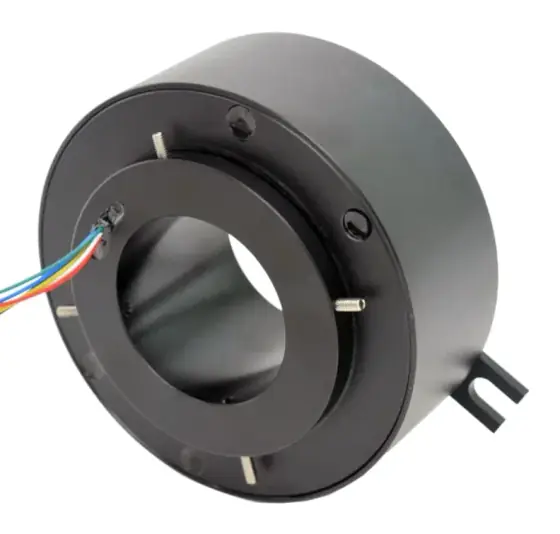
A slip ring on the pan axis lets a PTZ camera rotate endlessly while passing power, video or Ethernet, heater and wiper power, and tilt and zoom control. Speed domes use small capsule slip rings with gold contacts for low electrical noise; heavier positioners use through-bore or flat pancake units, and HD video slip rings carry uncompressed HD-SDI or HDMI. Specify every circuit's current and voltage, the video or Ethernet standard and data rate, maximum pan speed, IP rating, temperature range and life in revolutions. CT baggage scanners need very large-bore slip rings around the gantry.
- PTZ speed domes: power and Ethernet across endless pan
- Heavy pan-tilt positioners: power, video and heater circuits
- Thermal cameras: HD video and control across the pan axis
- CT baggage scanners: power and data to the rotating gantry
Available through our supply network
PTZ camera motors and pan-tilt drives
Pan and tilt axes are driven by small steppers, coreless or slotless DC motors through gearing or belts, or by brushless servo motors on heavy positioners. Steppers hold position without power draw from a controller loop and suit cost-sensitive domes; slotless brushless motors give smooth, cog-free slow tracking. Size the motor from payload inertia and preset speed, then check holding torque against wind load on outdoor units. Specify temperature range, voltage, noise, expected operating hours and any encoder or brake. Micro DC motors with high-ratio gearheads drive locks and latches.
- PTZ domes: pan and tilt stepper drives
- Long-range positioners: geared servo pan and tilt
- High-security locks: micro gearmotors for bolts and latches
- Pipe-crawler cameras: traction and camera-head motors
Available through our supply network
All servo and stepper motors →Specify servo and stepper motors for security and cctv →
Pan tilt encoders for surveillance cameras
Encoders close the loop on pan and tilt so presets are repeatable and tracking is smooth. The resolution follows from the preset accuracy: 0.02° needs at least 18,000 counts per revolution at the axis, and narrow-field thermal or zoom cameras need more. Thin hollow-shaft absolute encoders fit around the pan axis next to the slip ring and need no homing at power-up. Inductive and capacitive designs tolerate condensation, dust and wide temperature swings. Specify the interface, resolution at the load, accuracy, temperature and the bore you need for cables or the slip ring.
- PTZ positioners: absolute pan angle for presets
- Thermal cameras: fine tilt feedback for narrow fields of view
- Perimeter radar-camera slew-to-cue: fast, accurate pointing
Available through our supply network
All encoders and feedback →Specify encoders and feedback for security and cctv →
Actuators for automatic doors, gates and barriers
Electric linear actuators open windows, vents, gates and doors, operate latches, and on a larger scale raise hostile vehicle barriers. For doors, controlled force and speed matter as much as thrust, because EN 16005 deals with crushing, shearing and impact hazards for power operated pedestrian doors. Specify force, stroke, speed, cycles per day, IP rating for outdoor gates, the fail-safe or fail-secure position on power loss, and feedback such as Hall sensors or limit switches. Heavy roller-screw actuators are used in active security barriers.
- Automatic windows and vents: compact DC push-pull actuators
- Gates: outdoor IP66 actuators with limit switches
- Active security barriers: high-force roller-screw actuators
- Locks and latches: short-stroke actuators
Available through our supply network
All linear actuators →Specify linear actuators for security and cctv →
Direct-drive motors for camera heads and positioners
High-end surveillance positioners and stabilised camera heads can use frameless torque motors built straight onto the axis. With no gears there is no backlash or gear noise, tracking is smooth at very low speed and the large bore leaves room for cables or a slip ring. Specify continuous and peak torque at the axis, including wind load for outdoor units, lowest smooth tracking speed, bore and envelope, bus voltage and the encoder it will pair with. Ironless or slotless designs remove cogging where a slow, steady pan on a long lens must look smooth on screen.
- Stabilised camera heads: gearless pan and tilt
- Long-range surveillance positioners: direct-drive azimuth
- Gimbals: compact large-bore axes
Available through our supply network
All frameless and torque motors →Specify frameless and torque motors for security and cctv →
Compact servo drives for camera and door control
Small low-voltage servo drives run brushless pan and tilt motors, door operators and inspection crawlers from 24 to 60 V DC. Micro drives weigh tens of grams and fit inside a camera head; palm-sized drives suit doors and barriers. Look for the feedback interface your encoder uses, a fieldbus such as CANopen or EtherCAT where the system has one, STO where a moving door or barrier needs a safe stop, and an extended temperature version for outdoor housings. Efficiency matters in a sealed camera head, where drive losses add to the heat the housing must shed.
- PTZ heads: micro drives for brushless pan and tilt
- Automatic doors: compact DC servo control
- Inspection crawlers: battery-powered traction drives
Available through our supply network
All servo drives →Specify servo drives for security and cctv →
Standards to have in view
- BS EN 62676-1-1:2014 (video surveillance systems for security applications: system requirements)
- BS EN 62676-4 (video surveillance systems: application guidelines)
- EN 16005:2023+A1:2024 (power operated pedestrian doorsets: safety in use)
- IEC/EN 60529 (IP codes)
- NEMA 250 (enclosure types, US)
- IEC 62368-1 (audio/video and ICT equipment safety)
Which standards apply depends on the end product and its market. Your engineer will confirm what the component itself needs to meet.
Frequently asked questions
Why does a PTZ camera need a slip ring?
Endless 360° pan means the camera head turns continuously, so cables cannot simply twist. A slip ring passes power, video or Ethernet, heater and wiper power, and control signals for the tilt and zoom drives across the pan axis. Speed domes use compact capsule units; large positioners can use through-bore or pancake designs. Limited-rotation cameras can avoid the slip ring with a cable loop.
What motor is used in a PTZ camera?
Small and mid-size PTZ domes commonly use stepper motors or small brushless or coreless DC motors driving through gears or belts, because they hold position well and are simple to control. Heavier positioners use brushless servo motors or gearmotors with encoders. maxon, for example, recommends 16 mm brushless motors with planetary gearheads for surveillance cameras exposed to weather.
What encoder resolution does a pan-tilt camera need?
Set it from the preset accuracy and the narrowest field of view. A 0.02° preset accuracy needs at least 360 ÷ 0.02 = 18,000 counts per revolution at the axis, about 15 bits, and in practice 16 to 18 bits to leave margin for control. Long-range thermal and zoom cameras with very narrow fields of view need finer resolution still.
What slip ring does a CT baggage scanner use?
A large-bore slip ring around the rotating gantry, which carries the X-ray source and detectors. Schleifring describes scanner slip rings with internal diameters up to two metres, with image and signal data sent by contacting or contactless transmission depending on the requirement. Power for the X-ray tube and the high-rate detector data are the two hardest channels.
Which standard covers automatic doors?
EN 16005:2023+A1:2024 covers the safety in use of power operated pedestrian doorsets, including sliding, swing, revolving, balanced and horizontally folding doors. It deals with hazards such as crushing, shearing and impact, which is why door drives need controlled force, speed and reliable obstruction detection. Burglar-resistant and fire doors have their own standards.
What should I send for a CCTV or security enquiry?
Send pan and tilt ranges, speeds and accelerations, payload mass and inertia, preset accuracy, the circuits and data that must cross each axis, supply voltage, operating temperature, IP and impact rating, expected service life in hours or cycles, size limits and production volume. For doors and locks, add force, stroke, cycles per day and the fail-safe or fail-secure behaviour required.
Sources
- Axis Communications: AXIS Q8665-E PTZ network camera datasheet
- Dahua: SD6C23C/23E/36E PTZ dome datasheet
- maxon: security systems
- Schleifring: safety and defence applications (CT baggage scanners)
- NSAI: BS EN 62676-1-1:2014 video surveillance systems, system requirements
- BSI: BS EN IEC 62676-4 application guidelines (draft for comment)
- Genorma: EN 16005:2023+A1:2024 power operated pedestrian doorsets
- Security Buyer: BSIA guidance on choosing a reputable CCTV supplier
Figures are summarised from the sources above and from manufacturers' published data on the date shown. Always confirm against the current datasheet for your exact part.