
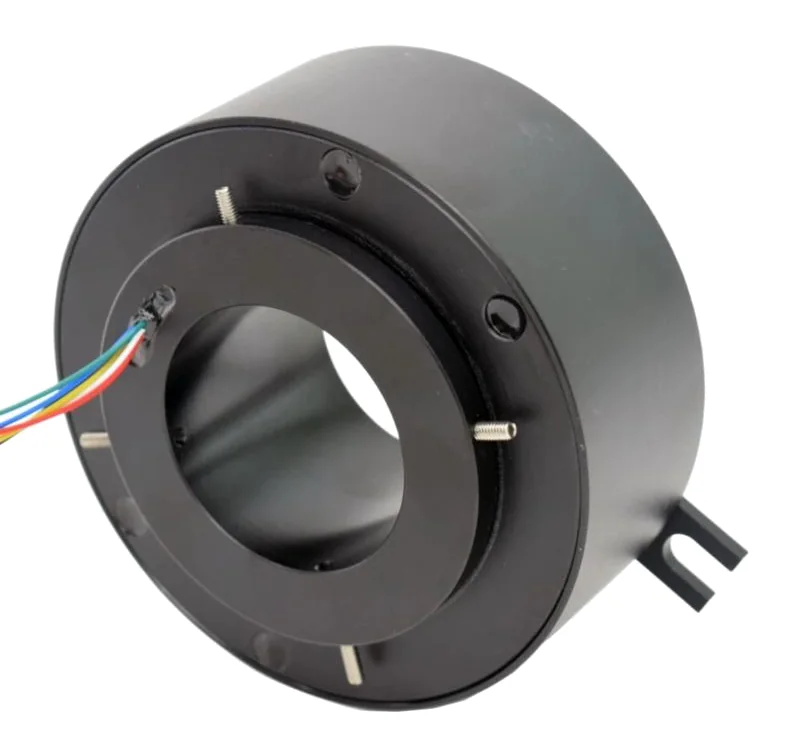
What the slip ring has to handle
- Ethernet channels rated for 10/100 or 1000BASE-T, or 50/75 ohm coax for HD-SDI video
- Low-voltage power and motor-control circuits, a few amps each
- Moderate speed: continuous pan at up to a few hundred rpm
- Wide outdoor temperature range
- Sealing to IP65 or better for outdoor housings
- Compact capsule form to fit within the pan/tilt head
- Long life with low maintenance, as units are often mast-mounted
Typical figures
| Data | 10/100/1000BASE-T Ethernet; HD-SDI (SMPTE 292M) and SD-SDI (SMPTE 259M) on coax |
|---|---|
| Current | 2-10 A power circuits (example Ethernet video ring); 2 A per circuit on example HD-SDI ring |
| Voltage | 240 V AC on power circuits (example unit) |
| Speed | Up to 250 rpm |
| Temperature | -40 C to +80 C |
| Ingress protection | IP65 variant available |
Example figures from the published sources listed below. Your requirement may differ; an engineer will confirm against your duty cycle.
Recommended slip ring types
Standards to consider
- IEEE 802.3 - Ethernet physical layers carried through the ring (10BASE-T to 1000BASE-T)
- SMPTE 292M / SMPTE 259M - HD-SDI and SD-SDI serial digital video interfaces
- IEC 60529 - IP code for outdoor camera enclosures
- IEC 62676 - video surveillance systems for security applications
The complete system
A slip ring rarely works alone. For cCTV & pan-tilt cameras it is usually specified together with:
- stepper or BLDC pan motor
- tilt motor
- motor driver
- encoder or home sensor
- PoE injector or power supply
Specifying these together avoids mismatched connectors, cable routes and feedback interfaces, and gives you one point of contact for the whole axis.
Common problems to design out
- Packet loss or link drop on gigabit Ethernet through the ring
- Video noise or sparkle on analogue or SDI video
- Water ingress in outdoor heads
- Contact wear from constant patrol rotation
Series used in this application
Frequently asked questions
Can a slip ring carry gigabit Ethernet for an IP camera?
Yes. Ethernet slip rings are available for 10/100 and 1000BASE-T, often alongside coax and power circuits in the same capsule. Ring layout and shielding are designed to preserve the cable's impedance.
Can I run PoE through a camera slip ring?
PoE is listed as a typical application for Ethernet video slip rings, which also carry separate power circuits. Check the current rating of the rings carrying the PoE pairs against your camera's draw.
What IP rating do outdoor pan-tilt slip rings need?
Base capsule units are often unsealed or only splash-protected, so outdoor heads either seal the housing or use an IP65-rated slip ring variant. Temperature ranges of -40 C to +80 C are common.