
In short:Choose an integrated servo motor when you have many small, spread-out axes (roughly 100 W to 1 kW on 24–70 VDC in most ranges) with moderate dynamics, because it removes cabinet drives and most motor cabling; then size it like any servo on torque and speed, but with margin for the drive's heat inside the motor, the DC supply's inability to absorb regenerated energy, and the fieldbus, feedback, IP rating and STO each axis needs.
What you are buying
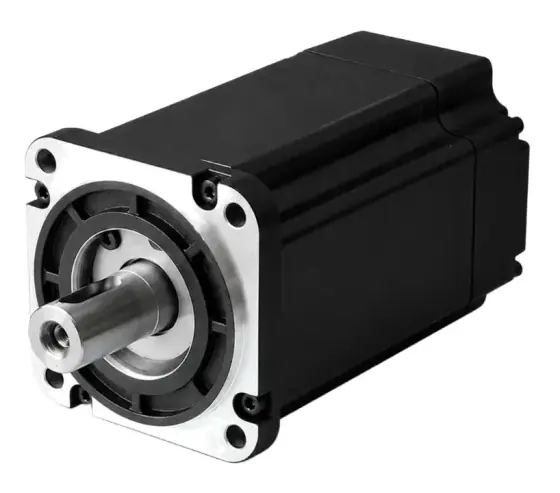
An integrated servo motor combines a brushless servo motor, encoder and drive in one housing, and often a motion controller or position table as well. It runs from a DC supply and takes its commands over pulse and direction, a serial link or a fieldbus. The cabinet loses a drive per axis; the machine loses most of its shielded motor and feedback cable.
In the ranges we supply, integrated servos cover roughly 100 W to 1 kW on 24–70 VDC, in 40, 57, 60, 80 and 86 mm frames, with CANopen, Modbus RTU, EtherCAT or Profinet depending on model. That power band defines where they fit.
Make the decisions in this order:
- Architecture: integrated or cabinet drives, axis by axis.
- Torque and speed: size as any servo, with thermal margin.
- Supply: DC bus voltage, power supply sizing, regenerated energy.
- Command interface: fieldbus, serial or pulse.
- Feedback: single-turn or multi-turn absolute; brake.
- Safety: STO where the risk assessment requires it.
- Environment: IP rating, ambient temperature, cable entries.
When an integrated servo beats cabinet drives
Motion Control Tips summarises the trade-off (Motion Control Tips):
Decentralised wins for spatially distributed axes such as conveying, and where EMC benefits from short motor leads. In a worked example for an eight-axis metal forming machine, Kollmorgen’s figures cut cabling from 248 m to 34 m, and from 372 m to 42 m once I/O is included. Heat is spread over the machine, so cabinet cooling can shrink.
Centralised still wins for synchronised axes that are physically close together and for highly dynamic, precise motion. High-power axes (the article cites a slicer) cannot be met with a decentralised drive.
Mixed architectures are often the answer: cabinet drives for the main synchronised axes, integrated servos for the auxiliary ones.
A practical way to decide, axis by axis:
| Axis character | Integrated servo | Cabinet drive |
|---|---|---|
| Power | up to about 1 kW | any, and above 1 kW |
| Location | far from the cabinet, spread out | close to the cabinet |
| Dynamics | moderate, low duty | high acceleration, high duty |
| Coordination | point-to-point, loose synchronisation | tight multi-axis interpolation |
| Ambient at the motor | moderate | hot, or near heat sources |
| Machine design | modular, many variants | one fixed build |
Format and size-change axes on packaging machines, conveyor sections, feeders, label and print positioning, and AGV and AMR drives are typical integrated-servo applications. Kinco’s iWMC goes further and integrates motor, drive, reducer, brake and tyre into an AGV wheel.
Sizing torque and speed, with thermal margin
Size the motor exactly as you would a separate servo: load inertia, acceleration torque, RMS torque over the cycle, peak torque and top speed. Keep the load-to-motor inertia ratio around 10:1 or lower for good tuning, as general servo guidance suggests (Motion Control Tips); add a gearbox if needed. See how to select a servo motor for the full method.
Then add the integrated-specific checks:
- Derating with ambient. The drive reduces output as temperature rises to protect itself, so the motor may need to be larger than a separate-drive design. Rapid, repeated acceleration is the hardest case for heat (Motion Control Tips). Read the derating curve at your real ambient and mounting.
- Mounting as a heatsink. Many integrated units rely on the mounting flange to shed heat. A plastic bracket or a small plate changes the rating.
- Peak current from the supply. On low voltage, current is high: iSV2 models list up to 19 A continuous and 57 A peak; Kinco’s MD up to 80 A peak. Supply cables, connectors and fuses must carry it.
Supply: DC bus, power supply and regenerated energy
Integrated servos run from 24–70 VDC depending on model. Higher voltage within the allowed range gives more speed for the same winding and lower current for the same power.
Size the power supply on the sum of the axes’ mean power plus the peaks that can coincide. Axes accelerating together, and an emergency stop where all axes decelerate together, are the cases to check.
Plan for regenerated energy. When a servo decelerates a load, energy flows back into the supply. Kollmorgen’s guidance on regenerated energy notes that axes on a shared bus can share it, but in a full-machine stop all axes decelerate at once (Motion Control Tips, Kollmorgen). A switched-mode DC power supply generally cannot absorb returned energy, so the bus voltage rises. Ask whether the integrated servo has an internal brake chopper, and whether the supplier recommends a regeneration clamp or capacitor module on the DC rail.
Separate logic supply. Several models (iSMD, the iWMC wheel) take a separate 24 V logic supply. Keeping logic alive while motor power is removed lets the axis retain position and report faults after a stop.
Command interface and fieldbus
| Interface | Typical use | Notes |
|---|---|---|
| Pulse and direction | replacing a stepper; simple PLC pulse outputs | one cable per axis; no diagnostics |
| Modbus RTU (RS485) | simple indexing from a PLC or HMI | slow update; position tables in the motor |
| CANopen | AGVs, mobile machines, modular equipment | CiA 301/402 profiles; robust on low-voltage vehicles |
| EtherCAT | coordinated multi-axis with a motion controller | daisy-chained, cyclic; distributed clocks synchronise nodes to well under 1 µs (ETG) |
| Profinet | machines on Siemens-based control | check the drive profile supported |
Choose by how the axes are coordinated. Independent positioning axes are fine on Modbus or CANopen. If integrated axes must move together, or with cabinet axes, put them on the same EtherCAT or Profinet network as the controller.
Feedback, brake and position after power-off
- Single-turn absolute (Kinco iSMK, iWMC) or high-resolution incremental (iSV2’s 17-bit magnetic encoder with ABZ output) suits axes that home at start-up.
- Multi-turn absolute avoids homing after power-off through a screw or gearbox. Kinco’s iSMD offers magnetoelectric or mechanical multi-turn absolute versions. Format-change axes benefit: the machine knows every guide position at power-up.
- Holding brake is needed on vertical axes and anything that back-drives. Check how it is powered; Kinco notes that the iSMK brake version needs an external brake module.
Safety
STO (safe torque off) removes the motor’s torque-producing power and corresponds to stop category 0 of EN/IEC 60204-1; SS1 corresponds to stop category 1 (Pilz). Many integrated servos do not have STO; some, such as Kinco’s iSMD, offer it as an option. If your risk assessment requires STO on an axis, pick a model with it, confirm the rated PL or SIL in the manual, and route the safety wiring to every unit. Removing the DC supply through a safety contactor is the alternative, at the cost of losing logic power unless it is supplied separately.
Environment and IP rating
Integrated units vary widely. Kinco’s iSMK is IP65 as standard with IP67 optional; the iSMD comes in IP20 or IP65 versions; the earlier MD body is IP20 with an IP54 shaft end. An IP20 integrated motor on an open machine frame is exposed to dust, coolant and cleaning. Match the rating to the location, and check the connector and cable gland ratings too.
Worked example: eight format-change axes on a cartoner
Requirement. Eight axes reposition guide rails and stops when the product size changes. Each moves a carriage through a 5 mm lead screw (efficiency about 0.9) against 300 N of drag. Adjustment up to 100 mm in 5 s. Axes are spaced 0.75 m apart along a 6 m machine, the first 2 m from the cabinet. The machine must know every position at power-up.
Torque and speed per axis.
- Screw torque: T = F × lead / (2π × η) = 300 × 0.005 / (2π × 0.9) ≈ 0.27 Nm
- Add bearing and seal drag, say 0.1 Nm (assumed): ≈ 0.37 Nm
- Speed: 100 mm in 5 s = 20 mm/s = 240 rpm (with ramps, peak about 300 rpm)
A 200 W class integrated servo rated around 0.64 Nm at 3,000 rpm has ample margin; the axis spends most of its life stationary, so heat is not a concern.
Feedback. Position must survive power-off through a screw: multi-turn absolute. A single-turn unit would need a homing run on every size change.
Interface. The axes move independently and only at changeover. EtherCAT to the machine’s main controller lets the recipe set all eight targets; CANopen or Modbus would also work if the controller supports it.
Cabling (illustrative). With cabinet drives, the motor distances are 2.0, 2.75, … 7.25 m: about 37 m in total, doubled for separate power and feedback cables to about 74 m of shielded cable, plus eight drives in the cabinet. Integrated, a DC supply line and a fieldbus line run along the machine with short drops: around 15–20 m in total, and no drives in the cabinet.
Supply. Eight axes × a few watts of mean power is small, but the supply must cover simultaneous moves at changeover. Decelerations of a slow screw axis return little energy; a regeneration clamp is still prudent if all axes can stop together.
Result. An integrated servo with multi-turn absolute feedback, EtherCAT, IP65 and a brake only where a guide could move under vibration. Kinco’s iSMD with the multi-turn option fits; at 400 W it is larger than the torque needs, so compare it with smaller-frame options and with a closed-loop integrated stepper such as the Novanta Liberty MDrive with absolute feedback.
Products in our range to consider
- Leadshine iSV2: integrated low-voltage servo, 200–750 W on 24–48 VDC, 17-bit encoder, CANopen or Modbus/pulse, up to 300% overload.
- Kinco iSMK: integrated DC servo in 40, 60 and 80 mm frames, 100–750 W, CANopen, Modbus or EtherCAT, IP65 standard.
- Kinco iSMD: integrated servo, 400 W to 1 kW, multi-turn absolute options, optional STO and brake, IP20 or IP65.
- Kinco MD: first-generation integrated servo for logistics, 200–750 W, 16-bit absolute, pulse, CANopen, EtherCAT or Profinet.
- Kinco iWMC: complete AGV drive wheel with motor, drive, reducer and brake, 3.6–40 Nm rated, for robots carrying up to 1 tonne.
- Novanta IMS Liberty MDrive: integrated closed-loop stepper, NEMA 17/23/34, CANopen, EtherNet/IP, Profinet or Modbus TCP options.
- Tolomatic IMA: rod actuator with a built-in servo motor driving a ball or roller screw, up to 30.6 kN.
- Kinco AK: CODESYS EtherCAT motion controller for up to 32 axes, to coordinate integrated and cabinet axes together.
What else the build needs
- DC power supply sized for coincident peaks, with a regeneration clamp or capacitor if needed, and a separate 24 V logic supply where the motor supports it.
- Fieldbus master: a PLC or motion controller. See motion controllers and how to select a motion controller or PLC.
- Gearbox for high-inertia loads: see how to select a planetary gearbox.
- Safety relay or controller for STO wiring.
- Cables and connectors: power, bus and I/O, rated for the IP class and any flexing.
- Mechanics: screws, actuators or wheels. See linear actuators.
- Compare with cabinet-mounted options in servo drives and with closed-loop steppers.
Things that catch engineers out
- Sizing on the motor rating without the derating curve. The drive inside limits continuous torque at high ambient.
- Fitting to a plastic bracket. The flange is often the heatsink.
- No plan for regenerated energy. A DC supply cannot absorb it; bus voltage rises on a group stop.
- Underrated supply cables. At 48 V, 750 W axes draw tens of amps at peak.
- Single-turn feedback through a screw. The axis must home after every power-up.
- Assuming STO is built in. On many models it is an option or absent.
- IP20 units on open frames. Check the body, shaft and connector ratings.
- Mixing too many interfaces. Keep coordinated axes on the same network as the controller.
Checklist
Send these to our engineers, or enter them in the spec builder:
- Number of axes, their positions on the machine and distance from the cabinet
- For each axis: load, inertia, move profile, peak and RMS torque, top speed
- Orientation and whether a brake is needed
- Supply voltage available (24, 48, 60 VDC) and whether logic can be supplied separately
- Command interface and the controller or PLC model
- Feedback: incremental, single-turn or multi-turn absolute
- Safety functions required (STO, SS1) and target PL or SIL
- Ambient temperature, mounting, IP rating, washdown or coolant
- Gearbox or mechanics already chosen
- Expected annual volumes
For the wider family, see our servo and stepper motors overview.
Frequently asked questions
What is an integrated servo motor?
A brushless servo motor with its drive electronics, and often a motion controller or indexer, built into the motor housing. It takes a DC supply and a command (pulse and direction, Modbus, CANopen, EtherCAT or Profinet) and needs no separate drive in the cabinet. Ranges in our network cover about 100 W to 1 kW on 24–70 VDC, in 40–86 mm frames.
When is an integrated servo better than a servo drive in the cabinet?
When axes are spread across a machine, are low to medium power, and are not all highly dynamic. Typical cases are format and size-change axes, conveyors, feeders, modular machines and mobile robots. A Kollmorgen worked example on an eight-axis machine cut motor and drive cabling from 248 m to 34 m. Highly dynamic, closely synchronised or high-power axes still usually suit cabinet drives.
Do integrated servo motors run hotter?
The drive's losses are added to the motor's, and the electronics have a lower temperature limit than the windings. Motion Control Tips notes that integrated drives derate as ambient temperature rises, that motors may need to be larger than otherwise necessary, and that rapid acceleration and deceleration are particularly hard because heat is difficult to dissipate. Check the derating curve at your real ambient.
Can an integrated servo motor hold position after power-off?
Only if it has absolute feedback and, for vertical or back-driven loads, a holding brake. A single-turn absolute encoder knows position within one revolution; through a screw or gearbox you need multi-turn absolute to avoid homing. Kinco's iSMD, for example, offers magnetoelectric or mechanical multi-turn absolute versions and an optional brake.
Do integrated servo motors have safe torque off?
Some do, as an option. Kinco's iSMD lists optional STO; others in the market have none. If the risk assessment needs STO on an axis, choose a model with it and confirm the rated safety level (PL or SIL) in the manual. STO corresponds to stop category 0 of EN/IEC 60204-1: power to the motor is removed and it coasts.
Sources
- Motion Control Tips: Centralized or decentralized motion architecture, which is best?
- Pilz: International standard EN / IEC 61800-5-2 (safety functions and stop categories)
- Motion Control Tips (Hurley Gill, Kollmorgen): Selecting regenerative resistors to harvest servomotor energy
- EtherCAT Technology Group: EtherCAT technology overview
- Motion Control Tips: How do I determine what gear ratio I need for my servo system?
Figures are summarised from the sources above and from manufacturers' published data on the date shown. Always confirm against the current datasheet for your exact part.