
Use this guide with the specification guide
This page is the short path to the right type of slip ring. Once you know the type, our how to specify a slip ring guide walks through the full specification: motion, circuit list, signals, speed and life, envelope, environment and other media. If your main question is data, read Ethernet through slip rings.
Four questions that pick the type
Answer these in order. Each one narrows the field.
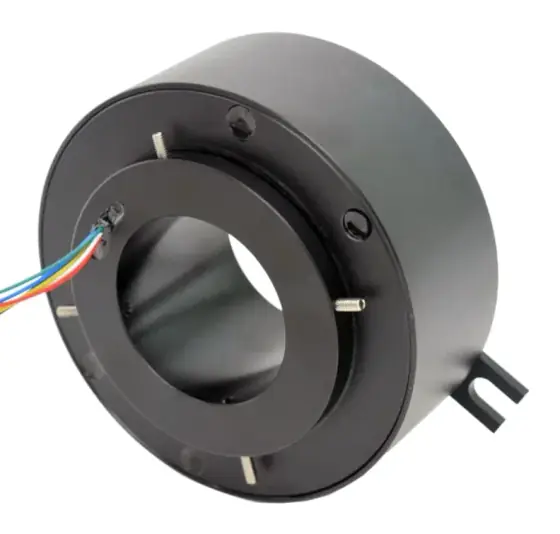
1. Does anything have to pass through the centre? A shaft, a pipe, cables, a fibre or a waveguide on the axis means a hollow unit: through-bore, or a pancake if axial height is very limited. If nothing passes through and space is tight, a capsule is usually the answer.
2. How much current and voltage? Signal and low power fit almost any type. Capsules are typically around 2 A per circuit in Moog’s range, through-bores 5 to 30 A, and large platter and drum designs to 100 A (Moog). Beyond that, or at high voltage, move to a high-current slip ring, often with carbon or copper-graphite brushes. Rate only the circuits that need it: Moog advises designating just those as high-current, and quoting surge and continuous current separately (Moog).
3. What data must cross? Moog says most smaller slip rings carry signals up to about 50 Mbit/s, with special designs reaching DC to 1 GHz and 500 Mbit/s or more (Moog). For fieldbus and industrial Ethernet, use an Ethernet slip ring tested for the protocol. For very high bandwidth, many channels of video, or severe electrical noise, use a fibre optic rotary joint (FORJ), alone or combined with electrical rings.
4. What else must cross the rotation? Air, vacuum, coolant or hydraulic oil need a rotary union. If you also need power and signals, a hybrid unit combines them on one axis.
Then check speed and envelope. Above a few hundred rpm, or on large diameters, you are into high-speed or large-diameter designs.
Slip ring types at a glance
| Type | Choose it when | Watch out for |
|---|---|---|
| Capsule | Space is tight, nothing passes through, mixed low power and signals | Limited current per circuit; small bore or none |
| Through-bore | A shaft, pipe or cable passes through the axis | Larger diameter for the same circuits; speed falls as bore grows |
| Pancake | Length is at a premium but diameter is not | Higher surface speed at the outer rings; flat face needs a flat, true mounting |
| High-current | Heavy power for motors, heaters, cranes, welding | Size, mass, brush wear and maintenance; separate signal rings from power |
| Ethernet | Fieldbus or Ethernet on a rotating platform | Needs rated, tested circuits; Gigabit needs four pairs |
| High-speed | Test rigs, spindles, turbines, balancing | Lower current; contact technology chosen for speed (fibre brush) |
| Fibre optic rotary joint | Very high bandwidth, video, EMI immunity, long distances | Insertion loss budget; fibre type (single or multi-mode) must match |
| Rotary union | Air, vacuum, water, oil or gas must cross rotation | Pressure, media compatibility and seal life |
| Hybrid (electrical + media, fibre or RF) | Several services must cross one axis | Longer lead time; one integrated design to agree in detail |
| Large-diameter | Big through-holes on heavy plant, turntables, radar | Low speed limit, heavy, often supplied as separates |
| Marine or rugged | Wet, salty, shock and vibration or qualification testing | Sealing, materials and test standards must be stated |
Contact technology follows the job. Gold-on-gold contacts give low electrical noise for signals; fibre brushes give long life and low wear debris at high speed; carbon and copper-graphite brushes carry very high current (Moog). Many units mix them: precious-metal rings for signals and carbon brushes for power.
Speed and life by type
Moog notes that almost any slip ring can run to about 100 rpm, and that its standard capsule and through-bore ranges are typically around 250 rpm (Moog, Moog). High-speed fibre brush capsules reach 10,000 to 20,000 rpm, while FORJs typically range from 100 to 1,000 rpm. Speed and diameter together set the ring’s surface speed, which drives contact material and design choices, so a large pancake or through-bore has a lower rpm limit than a small capsule.
State whether motion is continuous or oscillating, and the life in revolutions. Oscillating motion over a few degrees concentrates wear on one patch of each ring.
Worked example: a rotating heated process drum
Requirement: A process drum turns continuously at 20 rpm on a 50 mm shaft that must pass through the slip ring. On the drum: a 400 VAC three-phase heater at 16 A per phase, six temperature sensors, a remote I/O block on 24 VDC, and compressed air at 6 bar to a purge valve. The plant uses EtherCAT. Washdown area.
Question 1, centre: the shaft passes through, so a through-bore unit with a bore over 50 mm.
Question 2, power: three phases plus protective earth at 16 A and 400 VAC is moderate power, within through-bore ratings in many ranges, but the voltage rating must be confirmed. Add two circuits for the 24 VDC I/O supply. Fit surge protection on the heater supply, which Moog identifies as the main cause of failures.
Question 3, data: rather than taking six low-level temperature signals across the rings, mount the remote I/O on the drum and convert them there. That leaves one 100BASE-TX EtherCAT link, two pairs, on Ethernet-rated circuits.
Question 4, other media: compressed air needs a rotary union channel. Combined with the electrical circuits, this points to a hybrid pneumatic and electrical through-bore unit.
Circuit list: 4 power (L1, L2, L3, PE), 2 × 24 VDC, 4 Ethernet, plus 2 spares: 12 electrical circuits and 1 air channel.
Speed: 20 rpm is well within typical ratings, so the choice is set by the bore, power and air, not speed.
Environment: washdown means sealing to a stated IP rating and materials suited to the cleaning chemicals.
Choice: a hybrid pneumatic and electrical slip ring with a through-bore over 50 mm, such as the Pneumatic/Hydraulic Integrated Electrical Slip Ring in our range (bores to 85 mm, 30 A per circuit), confirmed for 400 VAC, the Ethernet channel and IP rating. Mount it with a flexible drive tab on one side only; Moog warns that hard-mounting both rotor and stator loads the slip ring bearings and causes early failure (Moog).
Products in our range to consider
- AR/BR/CR Series capsule slip rings: compact gold-contact capsules from 5.5 mm OD, up to 76 circuits.
- ER Series through-bore slip ring: standard bores from 12.7 to 100 mm, up to 15 A per circuit, fieldbus and Ethernet options.
- PR/PSR Series pancake slip ring: flat disc rings from 6 mm thick, bores to 500 mm.
- BHR Series frameless carbon brush slip ring: heavy-duty rings to 500 A per circuit and 20 kV.
- Ethernet slip ring: 100M or Gigabit channels with power, bores 25.4 to 100 mm.
- High speed slip ring: built for 800 to 15,000 rpm, mainly test rigs.
- FR Series fibre optic rotary joint: 1 to 50 optical channels, to 2,000 rpm.
- QR Series pneumatic/hydraulic rotary joint: up to 20 media channels plus electrical circuits, vacuum capable.
- Pneumatic/Hydraulic Integrated Electrical Slip Ring: hybrid with up to 16 gas or liquid channels at 10 MPa and up to 48 circuits.
- Fibre Optic Integrated Electrical Slip Ring: fibre channels with power and signal circuits in one unit.
What else the build needs
- Drive and motor for the rotating axis: see servo and stepper motors, frameless torque motors and servo drives.
- Gearing if the rotation is driven through a reducer with a hollow output: see gearboxes and how to select a gearbox.
- Feedback: an encoder on the rotating axis, and encoder signals across the ring if the encoder is on the rotor. See encoders.
- Remote I/O or fieldbus on the rotor to cut circuit count. See motion controllers.
- Surge protection on power circuits, shielded and twisted cabling for data.
- Anti-rotation tab or flexible coupling, so only one side is hard-mounted.
Market examples: slip rings for robotics, packaging, wind turbines and test rigs.
Things that catch engineers out
- Choosing by circuit count alone. A ring with enough circuits can still be wrong for the data, the voltage or the bore.
- Analogue low-level signals across the ring. Thermocouples, strain gauges and small analogue signals pick up noise and contact effects; digitise them on the rotor where possible.
- General-purpose rings for Ethernet. Use rated, tested data circuits.
- Hard-mounting both sides. Use a flexible tab or coupling on one side.
- No surge protection on power supplies.
- Ignoring surface speed on large pancakes and through-bores.
- Separate media and electrical units stacked by hand, when a hybrid would be shorter and aligned.
Checklist
Send these to our engineers, or enter them in the spec builder:
- What passes through the centre, and the bore needed
- Envelope: maximum OD and length
- Power circuits: current (continuous and surge) and voltage for each
- Signals and data: protocol, speed and number of channels
- Other media: air, vacuum, fluid or fibre, with pressure, flow and fibre type
- Speed (rpm), continuous or oscillating, and life in revolutions
- Environment: IP rating, temperature, washdown, marine, shock and vibration
- Mounting arrangement and anti-rotation method
- Any standards or qualification tests required
- Quantities and timing
For the full specification method, see how to specify a slip ring, and for the wider family, our slip rings overview.
Frequently asked questions
What is the difference between a capsule and a through-bore slip ring?
A capsule slip ring is a small, self-contained unit with its own shaft and bearings, fitted on the end of a shaft or inside a housing. A through-bore slip ring has a hollow centre so a shaft, pipe or cable can pass through it. Moog's guidance is to use a through-bore where a bore is needed for a concentric shaft or hydraulic lines, and a capsule where space is limited.
When should I use a pancake slip ring?
Use a pancake (flat, disc-style) slip ring when axial length is at a premium but there is room radially. The rings sit concentrically on a flat face rather than stacked along the axis. They suit turntables, radar and display platforms and machines where only a few millimetres of height are available. The larger ring diameter means higher surface speed, so check the speed limit.
Can a slip ring carry Ethernet?
Yes, with circuits designed for it. 100BASE-TX needs two pairs and Gigabit Ethernet four, with controlled impedance and shielding. Ethernet-rated slip rings are tested for the link, while a general-purpose ring may drop packets or fail to negotiate. For bandwidth beyond copper, or where electrical noise is severe, a fibre optic rotary joint is the alternative. See our Ethernet guide for details.
How fast can a slip ring rotate?
Moog notes that almost any slip ring can run up to about 100 rpm, and its standard capsules and through-bores are typically rated around 250 rpm. High-speed designs with fibre brush contacts reach 10,000 to 20,000 rpm, used on test rigs and turbine instrumentation. Speed limits fall as ring diameter rises, because surface speed drives wear and heat.
What is a hybrid slip ring?
It is one rotary unit that combines electrical slip ring circuits with other media: a rotary union for air, vacuum, water or hydraulic oil, a fibre optic rotary joint, or an RF rotary joint. Combining them saves length, keeps everything on one axis and gives one part to align, at the cost of a more specialised, longer-lead-time product.
What is the most common cause of slip ring failure?
Moog states that voltage surges and spikes are the main cause of slip ring failures, and that spikes of ten or more times normal voltage can occur in some power supplies, so it strongly recommends surge protection. Mechanical causes are next: hard-mounting both rotor and stator, so misalignment loads the slip ring's own bearings.
Sources
Figures are summarised from the sources above and from manufacturers' published data on the date shown. Always confirm against the current datasheet for your exact part.