
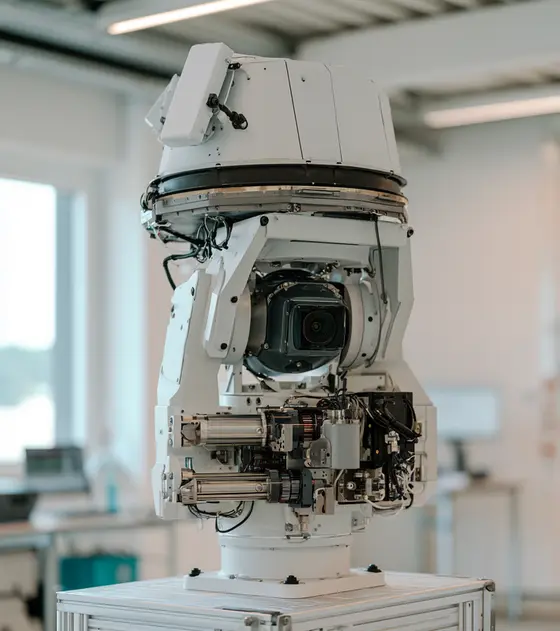
Typical requirements
| Fast pan-tilt slew rate (example) | 0.001–400 °/s, 15 kg payload, 10 Nm, 0.002° accuracy |
|---|---|
| Heavy positioner (example) | Up to 68 kg balanced at 0.005–60 °/s, 0.05° repeatability |
| UAV-mounted gimbal slew (example) | 200 °/s with continuous pan |
| Direct-drive gimbal stage encoder (example) | 26-bit absolute, 0.01° static pointing accuracy |
| Positioner supply (examples) | 24 V DC; up to 1 kW peak on a fast positioner |
| Positioner environment (example) | IP67 marine option; MIL-STD-810H Methods 514.8 and 516.8 |
Machinery we specify motion for
- Fast-slewing pan-tilt sensor positioners
- Rotating drone-detection radar heads
- RF direction-finding heads
- EO/IR tracking sensor heads
- Mast-mounted sensor heads
- Vehicle and vessel-mounted sensor platforms
Counter-UAS systems detect, track and identify small uncrewed aircraft, then hand them to an effector. This page deals only with the motion platforms for the sensors and effector mounts, at component level: the pan-tilt positioners, rotating radar and RF sensor heads, slip rings, encoders and drives. It does not cover how drones are defeated.
The motion requirement is unusual. A typical sequence is a cue from a wide-area radar or RF detector, a fast slew of an EO/IR or narrow-beam sensor onto that bearing, then smooth tracking of a small target that can change direction quickly. The platform may be a fixed tower, a mast, a vehicle or a vessel. So the axes need high acceleration, smooth low-speed tracking, stiffness, continuous rotation and robust data transfer, often all on a 24 or 28 V supply.
Fast-slewing pan-tilt positioners
Published positioners show how wide the envelope is:
| Example | Payload | Speed | Accuracy | Notes |
|---|---|---|---|---|
| DAT-CON PT Spirit | 15 kg | 0.001–400 °/s pan and tilt | 0.002° | 10 Nm, 24 V DC, 1 kW maximum, backlash-free, brake, Ethernet |
| Quickset TAURUS R | Up to 68 kg balanced | 0.005–60 °/s | 0.05° repeatability | 24 V DC, continuous pan via slip ring, IP67 marine option, MIL-STD-810H vibration and shock |
| Moog AC7332 gimbal stage | 1,112 N axial load capacity | Slew-to-cue and slow tracking (no rate published) | 0.01° static pointing | Direct-drive 32-pole BLDC, 26-bit encoder, integrated slip ring |
Sources: DAT-CON via Unmanned Systems Technology, Quickset TAURUS R datasheet, Moog AC7332 datasheet.
The trade-off is plain in the table: the fastest units carry lighter payloads. When specifying, start from the time allowed to reach a cued bearing, then derive acceleration and peak speed, then check that the payload’s inertia allows it.
Worked sizing example
A sensor head with 0.5 kg·m² of inertia about the pan axis must slew 90° in 0.5 s from rest to rest, using a symmetric accelerate-decelerate profile.
- Half the move (45°, 0.785 rad) takes 0.25 s, so acceleration = 2 × 0.785 / 0.25² ≈ 25 rad/s².
- Peak speed = 25 × 0.25 ≈ 6.3 rad/s, or about 360 °/s.
- Acceleration torque = 0.5 × 25 ≈ 12.5 Nm, before friction, slip ring drag, cable drag, wind and imbalance.
- Add margin (a rule of thumb is 30–50% for these unknowns) and you are at roughly 16–19 Nm peak, which points to a direct-drive frameless motor or a stiff, low-ratio, backlash-free gear stage.
Repeat for tilt, where gravity imbalance usually adds a steady torque.
Direct drives, gearing and motors
For the fastest and smoothest axes, direct-drive frameless torque motors remove backlash and keep stiffness high; Moog’s AC7332 uses a direct-drive 32-pole brushless motor. Where payloads are heavy and torque would make a direct drive too large, use preloaded zero-backlash gearing such as strain-wave sets; see harmonic vs planetary vs cycloidal and frameless motor sizing. Low-cogging motors help slow tracking, and a holding brake keeps the head parked for transport.
Radar, RF and EO/IR sensor heads
Rotating surveillance radars for drone detection use the same building blocks as larger radars: continuous azimuth rotation, an integrated slip ring, RF or fibre optic rotary joint and encoder. SPINNER notes that fibre optic rotary joints reach several Gbit/s and can be combined with slip rings and RF joints. Our radar pedestal page covers the joint stack. RF direction-finding heads and EO/IR turrets on the same mast often share a positioner, which drives up slip ring channel count. For EO/IR head design see the EO/IR gimbal page.
Slip rings for counter-UAS heads
Continuous pan is normal, so every head needs a slip ring carrying power, control and sensor data. For a gimbal mounted on a UAV or small head, low-torque miniature capsules such as Moog’s miniature gold capsules suit low-power circuits; for HD and thermal video plus Ethernet, use Ethernet slip rings or the higher-bandwidth EO/IR slip rings, which Moog rates at up to about two dozen channels over 400 Mbit/s each. Add a fibre optic rotary joint when copper runs out of bandwidth. Read Ethernet through slip rings and CCTV and pan-tilt slip rings.
Encoders and drives
Absolute encoders on each axis give position at power-up and support pointing to a cued bearing. They must handle the axis’s top speed and the platform’s shock and vibration; Netzer’s VLP, for instance, is rated to 100 g for 6 ms and 20–2,000 Hz vibration. See absolute vs incremental encoders.
The servo drive needs enough peak current for the acceleration above, a fast current loop for smooth tracking, and a network interface the system controller can command at high update rate. A motion controller or the sensor system computer closes the tracking loop.
Fixed, mast, vehicle and vessel mounting
The mounting platform changes the specification. A fixed tower gives a stable base, so the axes only need to follow the target. A telescopic mast adds sway in wind, and a vehicle or vessel adds pitch, roll and vibration that the axes must reject, which pushes the design towards the stabilised-gimbal approach: gyro feedback, stiffer structure and more continuous torque. Mobile heads also see transport shock and must park and lock for movement. State the mounting case up front, because it can double the torque and bandwidth required.
Environment, power and EMC
- Power. Positioners often run from 24 V DC; on military vehicles, design for MIL-STD-1275E or DEF STAN 61-5 Part 6. Fast slews draw high peak current.
- Environment. Outdoor heads need IP67-class sealing, wide temperature ratings, and vibration and shock testing to the tailored MIL-STD-810H profile; Quickset’s example cites Methods 514.8 and 516.8.
- EMC. Counter-UAS sites combine radar, RF receivers and jammers next to motor drives. Drive emissions can desensitise RF detectors, so MIL-STD-461 or DEF STAN 59-411 limits and good shielding are essential.
- Export control. Counter-UAS equipment and its specially designed components are likely to be controlled; see the defence and security overview.
Typical pitfalls
- Specifying maximum slew rate without acceleration.
- Choosing geared axes with backlash for a tracking task.
- Running out of slip ring bandwidth when a sensor is added.
- Ignoring drive emissions next to RF detectors.
- Forgetting tilt imbalance when payloads are changed in service.
Send your payloads, slew and tracking targets and data channels, and our engineers can propose positioner motors, slip rings, encoders and drives.
Direct-drive motors for fast pan-tilt positioners
A counter-UAS sensor head must slew quickly to a cued bearing, then track smoothly at low rates and reverse without lost motion, which is why direct-drive frameless motors suit the fastest heads. Size from the move: the worked example on this page reaches about 25 rad/s² and 12.5 Nm for a 0.5 kg·m² head moving 90° in 0.5 s, before friction, drag, wind and imbalance. Check continuous torque for tracking and wind on a mast or vehicle, cogging and ripple for slow tracking, and stiffness against the loop bandwidth. Specify bore for the slip ring, envelope, bus voltage and a holding brake for transport.
- Fast pan-tilt positioners: direct-drive pan and tilt
- EO/IR tracking heads: low-cogging smooth axes
- Rotating radar heads: direct-drive azimuth
- Vehicle-mounted heads: stiff, backlash-free axes
Available through our supply network
All frameless and torque motors →Specify frameless and torque motors for counter-uas systems →
Counter-UAS slip rings for sensor heads
Continuous pan is normal on counter-UAS heads, so every head needs a slip ring for power, control and sensor data, and data is where most rings run out. HD and thermal video, radar and RF receiver outputs usually travel over Ethernet, so specify the number of gigabit channels, video formats, power per ring and heater circuits, drag torque and speed. Add RF rotary joints for rotating radar or direction-finding antennas, and a fibre optic channel when copper bandwidth runs out. Multi-sensor heads drive channel count up quickly, so leave spare capacity. Specify sealing, temperature and vibration for the mounting case.
- Pan-tilt sensor heads: power, video and Ethernet across continuous pan
- Rotating radar heads: RF channels with power and data
- RF direction-finding heads: RF rotary joints
- Multi-sensor masts: high-bandwidth fibre and electrical hybrids
Available through our supply network
All slip rings →Specify slip rings for counter-uas systems →
Encoders for pan-tilt positioners
Absolute encoders on each axis give position at power-up and let the head point to a cued bearing without homing. For a fast head, the encoder must be rated for the top axis speed at the resolution you need, with low noise and latency for smooth tracking. Large-bore ring encoders fit around the slip ring in the hollow centre. Specify resolution, accuracy, maximum speed, interface (BiSS-C or SSI), update rate, temperature range and shock and vibration ratings for the mounting platform: one capacitive encoder on this page is rated to 100 g for 6 ms and 20 to 2,000 Hz vibration. Check immunity next to RF emitters.
- Pan-tilt positioners: absolute pan and tilt angle
- Rotating radar heads: azimuth feedback
- Vehicle and mast heads: rugged axis feedback
- Direct-drive axes: commutation and position
Available through our supply network
All encoders and feedback →Specify encoders and feedback for counter-uas systems →
Servo drives for fast slewing and tracking
The drive needs enough peak current for the slew acceleration, a fast current loop for smooth tracking, and a network the system controller can command at a high update rate. Fast slews draw high peak current, so on a military vehicle check input protection against MIL-STD-1275E surges and spikes and add energy storage if the supply sags. Counter-UAS sites combine radar, RF receivers and jammers next to motor drives, and drive emissions can desensitise RF detectors, so ask for emissions data, shield motor leads and filter inputs. Specify feedback interfaces, temperature range and how the drive brakes and parks the head on power loss.
- Fast pan-tilt positioners: high-peak-current axis drives
- Tracking heads: low-noise current control
- Vehicle-mounted heads: drives on 24/28 V power
- Rotating radar heads: constant-speed azimuth control
Available through our supply network
All servo drives →Specify servo drives for counter-uas systems →
Zero-backlash gearing for heavy sensor heads
Where the payload is heavy and a direct drive would be too large, preloaded zero-backlash gearing such as strain-wave sets or hollow-shaft harmonic actuators gives high torque without the lost motion that spoils tracking at every reversal. Keep the ratio low enough that the motor reaches the required slew speed, and check torsional stiffness, because gear compliance lowers the bandwidth the tracking loop can use. Size on peak torque for acceleration, holding torque on tilt with the worst imbalance, and shock during transport. Specify the hollow bore for the slip ring and cabling, lubricant temperature range and sealing.
- Heavy pan-tilt heads: zero-backlash pan and tilt reduction
- Tilt axes: holding against imbalance
- Mast-mounted heads: compact hollow-shaft actuators
- Multi-sensor platforms: stiff geared axes
Available through our supply network
All gearboxes and harmonic drives →Specify gearboxes and harmonic drives for counter-uas systems →
Motion controllers for multi-sensor positioners
A motion controller or the sensor system computer closes the positioner loops and turns cues from radar or RF detectors into coordinated pan and tilt moves. Where several heads share a mast or a head carries several axes, a controller on a deterministic network such as EtherCAT keeps axes synchronised and handles limits, parking and stow sequences. Specify the number of axes, network and update rate, the command interface from the system computer, how cue and track modes switch, and behaviour on loss of communication. Check operating temperature, enclosure and EMC ratings for an outdoor or vehicle installation.
- Multi-sensor masts: coordinated positioner axes
- Pan-tilt heads: cue, track and stow sequencing
- Vehicle platforms: networked axis control
- Fixed sites: remote diagnostics of positioners
Available through our supply network
All controllers and plcs →Specify controllers and plcs for counter-uas systems →
Standards to have in view
- MIL-STD-810H (environmental engineering and laboratory tests)
- MIL-STD-461H (control of electromagnetic interference; supersedes MIL-STD-461G)
- MIL-STD-1275E (28 V DC input power to utilisation equipment in military vehicles)
- DEF STAN 00-35 (environmental handbook for defence materiel)
- DEF STAN 59-411 (electromagnetic compatibility)
- IEC 60529 (IP codes)
Which standards apply depends on the end product and its market. Your engineer will confirm what the component itself needs to meet.