
Typical requirements
| Energy, all-electric vs old hydraulic moulder (one measured case) | 0.16 vs 0.61 kWh/kg, about 26% of the energy (Efficiency Vermont, 2005) |
|---|---|
| Energy saving claims, all-electric moulding | 50–70% vs hydraulic (vendor); about 15% vs modern variable-pump hydraulics (Husky) |
| Thermoforming retrofit (published case) | 20 to 37 cycles per minute after an electric roller-screw retrofit (Exlar) |
| Actuator efficiency (vendor figure) | About 90% electric roller screw vs about 50% hydraulic |
| Roller-screw actuator force (published ranges) | About 18 kN (RSA-ST) to 294 kN (RSX) per catalogue |
| UK plastics industry | About 5,700 companies and 160,000 direct jobs (BPF) |
Machinery we specify motion for
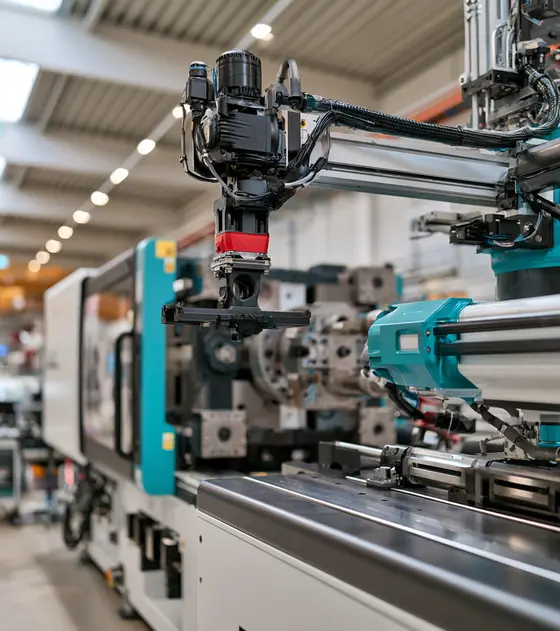
- Electric and hybrid injection moulding machines
- Blow moulding machines (extrusion and stretch)
- Extrusion lines, haul-offs and winders
- Thermoforming machines
- Plastic film and bag making
- Part ejection, mould positioning and sprue pickers
- Tyre building and green tyre transfer
- Rubber cutting and calendering
- Ultrasonic welding presses
What plastics and rubber machinery demands from motion
Plastics and rubber processing combines heat, high force and relentless cycling. An injection moulding machine may close, inject, hold and eject several times a minute, every minute, for years, with molten polymer at a few hundred degrees a short distance from the actuators. Extrusion and film lines run continuously for weeks. Tyre and rubber machinery adds heavy loads, sticky compounds and tight synchronisation.
The UK industry is substantial: the British Plastics Federation puts it at about 5,700 companies and around 160,000 people directly employed. Much of that capacity runs injection moulding, extrusion and thermoforming machines that are steadily being replaced or retrofitted, and every replacement is a chance to rethink the drive system.
Electric vs hydraulic: what the evidence says
The case for electric drives rests on energy, repeatability, cleanliness and noise. The energy figures vary widely, so treat them carefully:
| Source | Comparison | Result |
|---|---|---|
| Efficiency Vermont case study (measured, one week) | New 390-ton all-electric vs 1971 hydraulic machine | 0.16 vs 0.61 kWh/kg, about 26% of the energy |
| FANUC (vendor claim) | All-electric vs hydraulic | 50–70% less energy |
| Husky, quoted by PlasticsToday | Electric vs modern variable-displacement hydraulics | About 15% more efficient |
| Curtiss-Wright Exlar (vendor figure) | Roller-screw actuator vs hydraulics | About 90% vs about 50% efficiency |
The honest conclusion: replacing an old fixed-pump hydraulic machine saves a lot; replacing a modern servo-pump hydraulic machine saves less. The other benefits, shot-to-shot repeatability, no oil near the mould, lower noise and less cooling, often decide the case on their own. Our hydraulic to electric actuator guide walks through a conversion.
Where motion components sit on plastics machinery
| Machine | Axes | Main components |
|---|---|---|
| Injection moulding | Clamp, injection, screw rotation, ejector, core-pull, nozzle | Servo motors with roller screws or toggles, ejector actuators, drives, linear encoders |
| Blow moulding | Parison, mould clamp, carriage, blow pin, wheel rotation | Servo motors and actuators, slip rings on rotary wheels |
| Extrusion | Screw drive, haul-off, cutter, winder, traverse | Main motor and gearbox, servo haul-off and flying cutter, slip rings on winders |
| Thermoforming | Forming and trim platens, chain index, plug assist | Roller-screw actuators or servo toggles, servo index drives |
| Film and bag making | Seal bars, cut, fold, unwind tension | Servo motors, linear actuators, encoders |
| Tyre building | Drum rotation, transfer rings, ply servers | Servo motors, gearboxes, direct-drive motors, slip rings |
| Ultrasonic welding | Horn stroke and force | Electric servo press actuators |
Servotecnica’s slip ring catalogue lists blow moulding, plastic bag making and extrusion as plastics uses, and Exlar reports Dukane chose its GSX actuators for an ultrasonic welding press line.
How to size a thermoforming platen actuator: a worked example
Take a vertical forming platen with 120 kg moving mass, a 200 mm stroke completed in 0.35 s and a 15 kN forming force at the top of stroke, at 30 cycles per minute.
- Motion. A triangular profile gives peak speed v = 2 × 0.2 ÷ 0.35 ≈ 1.14 m/s and acceleration a = 4 × 0.2 ÷ 0.35² ≈ 6.5 m/s².
- Acceleration force. Lifting: 120 × (9.81 + 6.5) ≈ 1,960 N.
- Lead choice. For 1.14 m/s a 25 mm lead screw turns at 45.6 rev/s, about 2,740 rpm. A 10 mm lead would need about 6,840 rpm, too fast for most screws and motors.
- Torque at forming force. With the 25 mm lead and an assumed efficiency of 0.85: 15,000 × 0.025 ÷ (2π × 0.85) ≈ 70 Nm. During acceleration: 1,960 × 0.025 ÷ 5.34 ≈ 9 Nm plus rotor inertia.
- The two corners. The axis needs high speed at low force and high force at nearly zero speed. Check both points against the motor’s torque-speed curve. A large servo motor with about 120 Nm peak could do it directly, or a servo-driven toggle can give force multiplication near the end of stroke so a smaller motor runs faster.
- Heat. If the forming force is held for 0.5 s of each 2 s cycle, that alone gives an RMS torque of about 35 Nm. Size the motor’s continuous rating with derating for the hot machine environment.
The same two-corner check applies to injection units (fast fill, then high hold pressure) and clamp units (fast close, then full tonnage). See how to size a linear actuator and ball screw vs roller screw.
Injection moulding axes in detail
An all-electric injection moulding machine typically has four main servo axes: clamp (often through a toggle that multiplies force near lock-up), injection (a screw driving the plasticising screw forward), screw rotation for plasticising, and ejection. Some add nozzle touch and core-pull axes. Each has a different duty:
- Clamp. Fast open and close at low force, then full clamp tonnage held during injection and cooling. The toggle does most of the force multiplication; the motor sizes on speed and the brief lock-up peak.
- Injection. A fast fill at high speed, then pack and hold at high force and nearly zero speed. This is the most demanding two-corner axis on the machine.
- Screw rotation. Continuous torque during plasticising against back pressure. Size on RMS torque.
- Ejection. Short, fast moves with moderate force. A ball screw actuator usually suffices.
Hybrid machines keep hydraulics for the clamp and use servo drives elsewhere, or drive a hydraulic pump with a servo motor so it only runs when needed. When choosing between them, list each axis with its force, speed and duty, then decide axis by axis: the linear actuators, servo motors, gearboxes and servo drives hubs cover the options for each.
Extrusion, film and winding lines
Extrusion lines are continuous, so the motion problem is synchronisation and tension rather than force. Haul-offs set the pull speed, flying cutters match line speed for each cut, and winders control tension as the roll diameter grows. Servo motors with gearheads or direct-drive motors run these axes; encoders on measuring wheels set cut length. Winders with turret spindles need through-bore slip rings for power and signals. Heated rolls need a slip ring rated for the roll temperature, such as the High & Low Temperature Slip Ring range, published from -55 °C to 250 °C.
Rubber and tyre manufacturing
Tyre building machines rotate building drums, transfer the green tyre between stations and apply plies and treads in synchronised steps. The loads are heavy and the compounds sticky, so axes need high torque at low speed, stiff gearing and protection from contamination. Rotating drums carrying sensors or segment actuators need slip rings, and transfer rings use servo or electric linear axes. Specify drum inertia, index and acceleration times, and the synchronisation needed between drum and servers.
Things that catch engineers out
- Sizing only at peak force or only at peak speed. Check both corners of the torque-speed curve.
- Ignoring heat from barrels, moulds and heaters. Motors, encoders, lubricants and cables near the tool need derating or relocation.
- Hold time. Holding pressure or forming force heats motors as much as moving does.
- Thermocouple signals through slip rings. Low-level signals need clean contacts, shielding and separation from heater circuits.
- Lubricant contamination. Food, medical and optical mouldings may need food-grade or sealed actuators.
- Regenerative energy. Fast clamp and platen decelerations return energy; plan for it.
What to send an engineer
- Machine type, axis, and the force and speed at each step of the cycle.
- Stroke, cycle rate, hold times and moving mass.
- Ambient temperature at the mounting point and any heat sources nearby.
- Cleanliness, food-contact or medical requirements.
- Controller, fieldbus, encoder interface and safety functions.
- For conversions: hydraulic cylinder bore, rod, pressure and stroke.
Our engineers can propose matched actuators, motors and drives; start in the spec builder.
Electric actuators for injection moulding and thermoforming
Roller-screw and ball-screw rod actuators drive injection, clamp, ejector, core-pull, platen and trim-press axes. Electric axes give repeatable position and force from shot to shot without hydraulic oil near the mould. Specify peak force and when it occurs, stroke, peak speed and when it occurs, cycle rate, hold time, mounting and temperature at the actuator. Roller screws carry the high loads of clamp and injection axes for longer; ball screws suit lighter, faster ejector and handling moves. Check screw life at the equivalent load and keep lubrication away from food and medical mouldings.
- Injection moulding: injection and clamp axes
- Injection moulding: ejector and core-pull
- Thermoforming: forming and trim platens
- Ultrasonic welding presses: horn stroke and force
- Blow moulding: mould clamp and blow pin
Available through our supply network
All linear actuators →Specify linear actuators for plastics, rubber and tyre →
Servo motors for plastics machinery
Servo motors drive screw rotation, injection, clamp toggles, ejectors, extrusion haul-offs, cutters, winders and handling robots. Specify continuous and peak torque, speed, inertia ratio, encoder resolution and brake for vertical axes. Large frames with high peak torque suit clamp and injection drives; smaller low-inertia motors suit pickers and cutters. Motors near barrels and moulds see high ambient temperatures, so derate torque or relocate the motor. Multi-turn absolute feedback avoids re-homing after power loss with a part in the mould. Shaft seals and connectors must cope with oil mist, granulate dust and occasional mould release spray.
- Injection moulding: screw rotation and injection drive
- Extrusion: haul-off and cutter drives
- Film and bag making: sealing and cutting axes
- Sprue pickers and robots: handling axes
Available through our supply network
All servo and stepper motors →Specify servo and stepper motors for plastics, rubber and tyre →
Servo drives for injection moulding and extrusion lines
Plastics machines need drives that handle short, high current peaks during injection and clamping, regenerate energy during deceleration and talk to the machine controller over a real-time fieldbus. Specify supply, continuous and peak current, feedback protocol, fieldbus, STO and other safety functions, and how braking energy is handled. A shared DC bus lets one axis use the energy another axis returns. Check derating at the cabinet temperature found on moulding shop floors, which can run warm near barrels and heaters. Drives with good diagnostics and logging help trace intermittent faults, such as a clamp axis tripping on overcurrent only when the mould is hot.
- Injection moulding: injection, clamp and screw axes
- Extrusion: haul-off and winder tension control
- Thermoforming: platen and indexing drives
- Handling: robot and picker axes
Available through our supply network
All servo drives →Specify servo drives for plastics, rubber and tyre →
Gearboxes for extruder, haul-off and winder drives
Extruder screws, haul-offs, calenders, winders and indexing tables need high torque at low speed, often continuously for weeks at a time. Planetary gearheads give high torque density for servo axes; right-angle units fit tight layouts on winders and haul-offs. Specify continuous output torque at the real duty, peak and emergency-stop torque, ratio, output bearing loads, service factor and lubrication temperature. Main extruder gearboxes with thrust bearings for the screw are usually supplied by the extruder maker; auxiliary axes are where a servo gearhead fits.
- Extrusion: haul-off and puller drives
- Winders: spindle and traverse drives
- Thermoforming: chain index drives
- Rubber: calender and cutter feeds
Available through our supply network
All gearboxes and harmonic drives →Specify gearboxes and harmonic drives for plastics, rubber and tyre →
Slip rings for blow moulding wheels and extrusion winders
Rotary blow-moulding wheels, rotating mould carriers, winders and heated rollers need power, heater circuits, thermocouple and sensor signals, fieldbus and often air across the rotating joint. Specify circuits and current, heater power, low-level thermocouple signals (which need clean contacts and shielding), Ethernet if a fieldbus crosses the axis, air channels with pressure, speed, bore and temperature. High-temperature designs suit heated rolls; integrated pneumatic and electrical units save space on wheels. Ask for the rated life in revolutions against the wheel's annual running hours.
- Blow moulding wheels: heater power and sensors
- Winders: power and signals to turret spindles
- Heated rolls: element power and temperature signals
- Rotary moulds: air and electrical services
Available through our supply network
All slip rings →Specify slip rings for plastics, rubber and tyre →
Encoders for clamp, injection and extrusion axes
Linear and rotary feedback sets shot size, cushion, clamp position and cut length. Magnetic linear systems tolerate oil, dust and vibration on clamp and injection units; incremental magnetic sensors suit cut-to-length and haul-off measurement. Specify resolution and accuracy, measuring length, interface, temperature at the mounting point and protection against contamination. Absolute systems avoid a homing move after a stop, which matters when a part or melt is in the tool. Check that the scale's thermal expansion is compatible with the machine frame.
- Injection units: screw position and shot size
- Clamp units: platen position
- Extrusion: cut-to-length and haul-off speed
- Thermoformers: platen position
Available through our supply network
All encoders and feedback →Specify encoders and feedback for plastics, rubber and tyre →
Motion controllers for plastics machine sequencing
Plastics machines run a strict sequence: close, inject, hold, plasticise, open, eject. A multi-axis controller with EtherCAT coordinates servo axes, heater zones, robot handover and safety interlocks in one program. Specify axis count, cycle time, I/O, temperature control loops, HMI needs and communication to the factory system. For auxiliary machines such as pickers, cutters and winders, compact controllers with integrated HMIs keep costs down. Recipe handling for mould changes and data export for process monitoring are worth checking early, as are the interfaces to robots and mould temperature controllers.
- Injection moulding: cycle sequencing
- Extrusion lines: line speed and cutter synchronisation
- Thermoforming: platen and index coordination
Available through our supply network
All controllers and plcs →Specify controllers and plcs for plastics, rubber and tyre →
Standards to have in view
- EN ISO 20430 (injection moulding machines: safety; developed from EN 201)
- EN 422 (blow moulding machines: safety)
- EN 1114-1 (extruders and extrusion lines: safety)
- EN 12409 (thermoforming machines: safety)
- ISO 13849-1 (safety-related parts of control systems)
- IEC 61800-5-2 (drive safety functions, STO)
- Regulation (EU) 2023/1230 (machinery; applies from 20 January 2027)
Which standards apply depends on the end product and its market. Your engineer will confirm what the component itself needs to meet.