
Skip to content

Selection guide

Frameless motor integration checklist

Plan bearings, mounting, rotor retention, feedback and cooling when integrating a frameless torque motor into a joint or rotary mechanism.

UK engineering team · Product sourcing · Supply support

Apply this guide to your component requirement

Send your part number or describe what the machine needs to do. We connect your requirement with experienced UK engineering and procurement support to help you get the right products, pricing and supply options. Your matched provider can take the enquiry through quotation and ordering to delivery and after-sales support.

  • Source original parts or assess suitable alternatives
  • Get pricing, lead times and a defined supply proposal
  • One enquiry for components, complete axes and ongoing support

No obligation to buy. Choose the quick form below or use the full configurator on this page. Add what you know; an engineer can help with the details.

Need help choosing? Build a specification →
Add quantity, timing or application notes (optional)

Spec builder

Specify frameless and torque motors

Select the products and performance you need. Our UK engineering team can use your specification to help source the right components, pricing and supply options. See your summary before adding contact details.

Already know the part number? Use the quick enquiry form. You can configure a requirement below without registering.

  1. 1Products
  2. 2Performance
  3. 3Environment
  4. 4Volumes
  5. 5Your spec
Step 1 of 5

What are you specifying?

Select everything you need. A motor, drive and gearbox can be specified together as one axis.

1 selected: Frameless / torque motor
Specify Motion technical library · Updated · How we prepare our content · 2 sources

In short:A frameless motor kit is part of a larger assembly. The surrounding mechanism must provide the support, alignment, thermal path and feedback needed by the application.

Establish the complete assembly

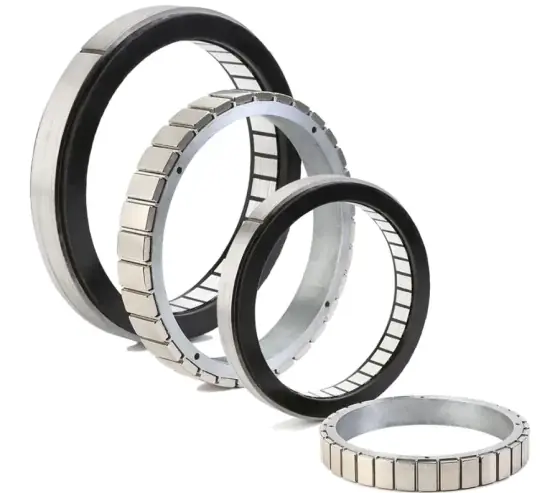
A frameless kit normally contains rotor and stator elements rather than a finished housed motor. Kollmorgen’s published explanation describes the housing, bearings, shaft and feedback as parts integrated into the machine. This changes the information needed for selection: a torque figure alone is not enough.

Record the available inner and outer diameter, axial length and required clear bore. Include bearings, seals, encoder, rotor support and cable routing in the envelope. Identify whether the motor drives the load directly or through gearing.

Checklist

AreaQuestion to resolve
BearingsWhat supports radial, axial and overturning loads?
AlignmentHow are air gap, concentricity and runout maintained?
Rotor retentionWhat locates and retains the rotor throughout the duty?
Stator mountingWhat installation method and tolerances does the manufacturer specify?
Heat removalWhat mounting structure, ambient and cooling conditions apply?
FeedbackWhat position and commutation information does the drive need?
Cables and sealingHow are exits, strain relief and environmental protection achieved?

Use the selected manufacturer’s installation instructions for materials, bonding, fits and assembly methods. This checklist does not provide manufacturing tolerances or a substitute installation procedure.

Check the installed thermal conditions

A motor’s continuous torque depends on stated thermal assumptions. The surrounding structure and heat path can change the available continuous performance. Describe the actual mounting material, nearby heat sources, cooling and duty rather than borrowing the performance of a different housed assembly.

Rotor, bearings, feedback and gearing can also be affected by the temperatures in the joint. Discuss the complete arrangement with the product supplier and responsible designer. Do not assume a motor kit has a complete-joint IP rating or environmental approval.

Match drive and feedback requirements

The drive needs a supported motor winding and suitable feedback or commutation information. Check supply, current conventions, motor constants, sensor signals and the exact encoder interface. Mechanical integration and electrical compatibility should be reviewed together.

For a gimbal or robot joint, record the load inertia, gravity torque, acceleration, smoothness, holding duty and reversal requirements. Include the location at which position performance must be measured. The gimbal application guide illustrates the wider component discussion.

Request a defined integration review

Send a section drawing or sketch, motion profile, envelope, cooling assumptions and intended drive. State prototype and expected production quantities. We can discuss frameless ranges and custom options, with the exact product capability and scope of engineering support confirmed for the enquiry.

Sources

  1. Kollmorgen: what a frameless motor contains
  2. Motion Control Products: frameless motor ranges

Figures are summarised from the sources above and from manufacturers' published data on the date shown. Always confirm against the current datasheet for your exact part.

Engineer support

Want an engineer to check your numbers?

Send us your figures and we can discuss a sizing review and suitable supply options. Availability and the support scope are confirmed for your requirement.

  • Reviewed by an engineer, not an autoresponder
  • Like-for-like and better-fit alternatives
  • Standard, modified and custom options

Prefer to configure it? Use the spec builder.

We use your details to answer this enquiry and share them with the specialist engineering and supply partner best placed to fulfil it. Read our introduction service terms and privacy notice.

UK engineering input · A route to buying the right products

From your enquiry to products, delivery and support

Specify Motion helps turn a part number or application into a purchasing enquiry. We provide recommendations and connect your requirement with a relevant engineering or procurement provider for product selection, pricing, sourcing and supply.

  1. Tell us what you needSend a code or configure the application, quantities and timing.
  2. Reach a relevant providerAccess experienced UK engineering input and a suitable procurement route.
  3. Review the quotationYour provider confirms the products, price, compatibility checks and supply terms.
  4. Order with delivery and support agreedConfirm delivery, warranty and after-sales arrangements with the contracting provider.

You choose whether to proceed with the provider and should carry out your own checks. Website and introduction service terms.