
In short:Armoured vehicle motion components must run from a noisy 24/28 V DC vehicle supply, seal against mud, water, washdown and NBC conditions, and survive tracked-vehicle shock and vibration for decades. Specify each actuator, mast drive and slip ring against the vehicle's power standard (MIL-STD-1275E or DEF STAN 61-5 Part 6) and its tailored environmental profile, and design manual override in from the start.
Typical requirements
| Vehicle supply (MIL-STD-1275E) | 28 V DC nominal; 20–33 V steady state; ±250 V injected spike test |
|---|---|
| Sealed DC linear actuator force (examples) | 500–800 N light duty; up to 16 kN dynamic heavy duty |
| Actuator ingress (examples) | IP66 dynamic; IP67 and IP69K static |
| Actuator salt spray (examples) | 500 hours |
| Actuator operating temperature (examples) | −40 °C to +70 °C or +85 °C |
| Turret ring slip ring power (examples) | 150–450 A per ring at 18–37 V DC; NBC air channel options |
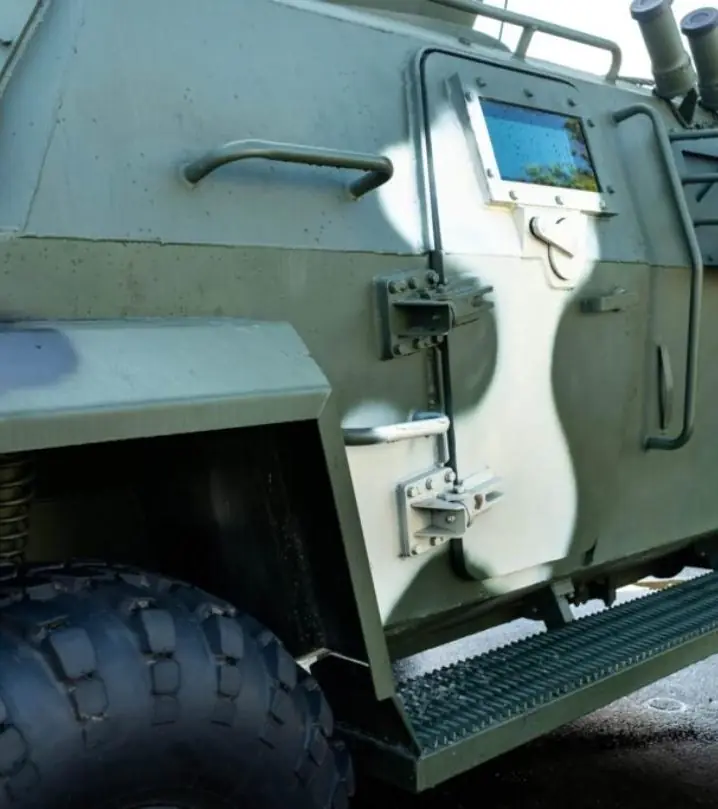
Armoured fighting vehicles, protected patrol vehicles, logistics trucks and specialist vehicles all carry a surprising amount of motion: hatches, doors and rear ramps, sensor and communication masts, turret ring interfaces, stowage and handling mechanisms, seats, steps and covers. Hydraulics used to do most of it. Electromechanical actuators are taking over where they save weight, remove fluid leaks and fire risk, and make diagnostics and control simpler. Whatever the technology, the parts live on the same hostile platform: a 24/28 V supply full of transients, mud and water, washdown and decontamination, extremes of temperature, and the shock and vibration of tracked or cross-country running.
Hatch, door and ramp actuators
A hatch actuator on an armoured vehicle has to move a heavy, often unbalanced lid against gravity, seals and possibly ice, then hold it securely. Ramps and doors are larger versions of the same task.
How to specify:
- Force. Calculate the torque about the hinge at the worst angle, including any gas strut or spring assistance, then convert to linear force at the actuator’s lever arm. Add margin for ice, dirt and seal friction.
- Holding. Use a self-locking screw, a brake, or an external lock. Decide what holds the hatch if the actuator fails.
- Manual override. Crews must be able to open and close the hatch with the actuator unpowered or jammed. That shapes the mechanism more than any other requirement.
- Speed and duty. Opening time, cycles per mission, and life cycles over the vehicle’s service.
- Feedback. End-of-stroke switches or an absolute position sensor for status and interlocks.
Sealed DC rod actuators from the off-highway world are a good indication of what is available. Thomson’s Max Jac is a light-duty 12/24 V unit built for mud, salt water and high-pressure washdown: 500–800 N dynamic, IP66 and IP69K, −40 °C to +85 °C and 500 hours salt spray. The Electrak HD reaches 16 kN dynamic and 18 kN static on 12, 24 or 48 V, with IP67 and IP69K static (IP66 dynamic), −40 °C to +70 °C and onboard control electronics. A defence programme then adds its own qualification on top. For higher forces or servo control, roller-screw actuators such as the Exlar Tritex TDX DC range are an option. See linear actuators, how to size a linear actuator, ball screw vs roller screw and the hydraulic to electric actuator guide.
Mast and sensor raising
Reconnaissance and command vehicles raise cameras, radars and antennas on telescopic or folding masts, and lower them for movement. The motion parts are a raising drive (linear actuator, screw or winch-driven mast), locking at height, and often a pan-tilt head on top with a slip ring for continuous rotation. Points to settle: stowed height, raised height and head payload; wind loading at full extension; raise and stow times; behaviour if power fails while raised (brake, lock, or controlled descent); and protection of cables and slip rings at the vehicle roof seal. The head’s pan-tilt and stabilisation requirements are covered in our EO/IR gimbal page.
Turret ring slip rings
Vehicles with rotating turrets or weapon stations need a slip ring at the turret ring for power, signals, video and data. Moog’s published vehicular slip rings combine power rings from 150 A to 450 A at vehicle voltages with up to 238 signal circuits, MIL-STD-1553, RS-170 video and Ethernet, full environmental sealing and EMI shielding. Several include an NBC air channel, so filtered air reaches the turret, and the VSR-7001 is immersible to 1 m for fording. See our turret and remote weapon station page, rugged military slip rings and defence turret slip rings.
Handling mechanisms (general component level)
Stowage, loading and other handling mechanisms inside a vehicle use the same rugged parts as other axes: sealed servo motors, gearboxes, brakes, absolute encoders and drives. Kollmorgen, for example, describes a rugged servo motor range rated to MIL-STD-810E and sealed to IP67, with a stainless shaft and chemical agent-resistant paint. At component level the priorities are reliable holding with power off, absolute position known at power-up, stiffness under vehicle vibration, and interlocks the vehicle integrator can use. Netzer’s encapsulated DS encoders, for instance, are rated to 100 g for 11 ms shock under MIL-STD-810G. See servo and stepper motors and servo drives.
28 V DC vehicle power: MIL-STD-1275 and DEF STAN 61-5
US-standard vehicles follow MIL-STD-1275E: 28 V DC nominal, 20–33 V steady state, with surges, injected spikes of 250 V peak in both polarities, cranking and starting disturbances, and ripple limits. UK vehicles follow DEF STAN 61-5 Part 6; XP Power notes that Issue 6 (2009) covers 12 V and 24 V systems and introduced a much more severe load dump (DIT08.B) than the 80 V for 80 ms worst case of Issue 5. Practical consequences for motion parts:
- Drive and actuator electronics need surge and spike protection rated to the right standard and issue.
- Low-voltage dips during cranking must not reset controllers or engage spring-applied brakes unexpectedly mid-move.
- High actuator inrush current must not itself violate the emission limits.
Sealing, NBC, washdown and shock
- Ingress. IP66 dynamic and IP67 static are a practical floor for external actuators; IP69K covers high-pressure washdown. Specify wading or immersion depth separately.
- Decontamination. Seals, paints and cable jackets must tolerate decontamination fluids; chemical agent-resistant coatings are common.
- Salt and mud. Salt fog (MIL-STD-810H Method 509) and sand and dust (510).
- Shock and vibration. Tracked vehicles are among the harshest vibration environments; test to the tailored Method 514 and 516 profile or DEF STAN 00-35.
- EMC. MIL-STD-461 or DEF STAN 59-411, with attention to actuator motor noise on vehicle radios.
- Export control. Components specially designed for military vehicles may be controlled; see the defence and security overview.
Typical pitfalls
- Designing manual override in last.
- Specifying actuators for 24 V nominal without the vehicle’s surge and dip envelope.
- Ignoring ice and seal friction in hatch force calculations.
- Leaving the NBC air path out of the turret slip ring specification.
- Qualifying a commercial actuator and then accepting an unannounced design change.
Send your function, loads, envelope and vehicle power standard, and our specialist engineering and supply partners can propose actuators, motors, slip rings and feedback suited to the vehicle.
Standards to have in view
- MIL-STD-1275E (28 V DC input power to utilisation equipment in military vehicles)
- DEF STAN 61-5 Part 6 (low-voltage electrical power supply systems in military vehicles)
- MIL-STD-810H (environmental engineering and laboratory tests)
- MIL-STD-461H (control of electromagnetic interference; supersedes MIL-STD-461G)
- DEF STAN 00-35 (environmental handbook for defence materiel)
- DEF STAN 59-411 (electromagnetic compatibility)
- IEC 60529 (IP codes)
Which standards apply depends on the end product and its market. Your engineer will confirm what the component itself needs to meet.
Frequently asked questions
What is MIL-STD-1275E?
It is the US military standard for the characteristics of 28 V DC input power to equipment in military ground vehicles. It defines the steady-state range (20–33 V), surges, spikes (injected spike tests at 250 V peak in both polarities), starting disturbances such as cranking and ripple, and limits on what equipment may emit back onto the bus. Actuator drives and servo electronics must operate or survive through these events as the standard specifies.
What does a hatch actuator for an armoured vehicle need?
Enough force to move a heavy armoured hatch against gravity, seals and ice, on the vehicle's 24/28 V supply; a self-locking screw or brake to hold position; a manual override that works with the actuator unpowered or jammed; sealing to at least IP66 and IP67 with washdown resistance; and a temperature range of about −40 °C upward. Specify open and close times, cycle life and end-of-stroke detection.
Are commercial off-highway actuators usable on military vehicles?
Often as a starting point. Sealed DC rod actuators built for agricultural and off-highway machinery already offer IP66, IP67 and IP69K ratings, 500-hour salt spray and −40 °C operation. What a defence programme adds is qualification to its tailored MIL-STD-810H or DEF STAN 00-35 profile, EMC testing, tolerance of MIL-STD-1275 or DEF STAN 61-5 supply events, and long-term supply and configuration control.
What is an NBC air channel on a turret slip ring?
A passage through the slip ring that carries filtered air across the rotating turret interface, so the crew compartment's collective protection or overpressure system can serve the turret. Moog lists NBC air channel options on several of its vehicular turret slip rings, alongside power, signal, video and data channels.
How do I protect actuator electronics from vehicle load dump?
Specify the vehicle power standard and issue, and ask the supplier for evidence that the actuator or its controller meets the surge, spike and cranking requirements. UK DEF STAN 61-5 Part 6 Issue 6 introduced a more severe load dump than earlier issues, which XP Power quotes at 202 V peak for the DIT08.B test. Many designs add a front-end surge suppression and filter module to the actuator supply.
What should I send for an armoured vehicle motion component enquiry?
Send the function (hatch, door, ramp, mast, turret ring, handling mechanism), load, stroke or angle, speed, duty cycle and life, mounting envelope, vehicle supply standard, manual override and fail-safe behaviour, ingress, washdown and NBC requirements, temperature, shock and vibration profile, EMC standard, feedback needs and production quantities.
Sources
- Interference Technology: review of MIL-STD-1275 requirements
- XP Power: DEF STAN 61-5 Part 6 Issue 6 compliance
- Moog: aerospace and defence slip ring product catalogue (vehicular and turret slip rings)
- Thomson: Max Jac linear actuator
- Thomson: Electrak HD linear actuator
- Kollmorgen: motion solutions for weapon stations (rugged servo motors)
- Netzer: product catalogue 2025
Figures are summarised from the sources above and from manufacturers' published data on the date shown. Always confirm against the current datasheet for your exact part.