
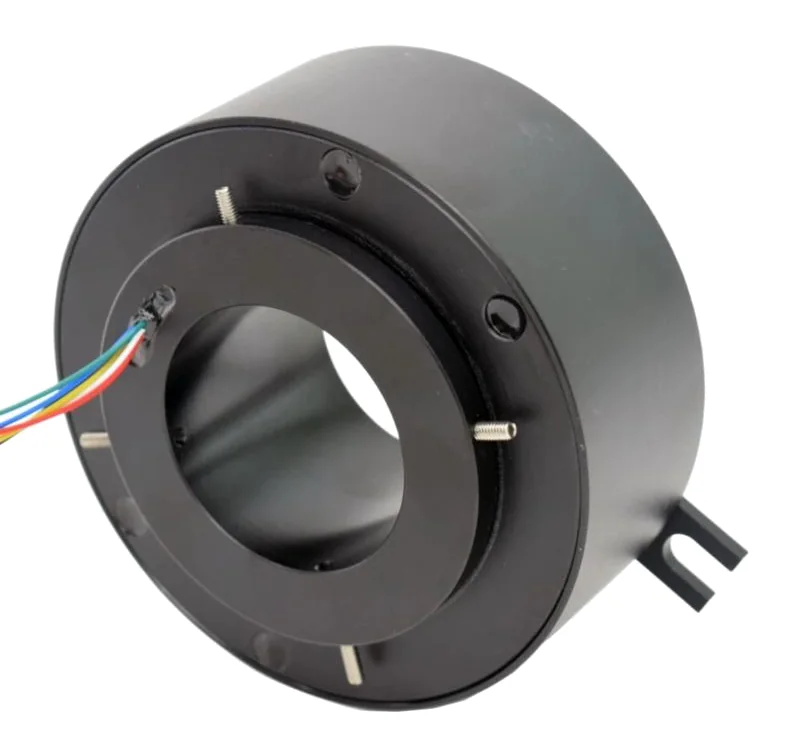
What the slip ring has to handle
- Medium- and high-voltage power swivels (tens of kV)
- Low-voltage electrical swivels for power and signals
- Fibre optic swivels with many passes
- Hazardous-area certification (flameproof, pressurised, increased safety, intrinsic safety)
- Large hollow bores (metres) for fluid swivel stacks
- IP66-IP68 marine sealing
- Classification-society verification and long life
Typical figures
| Voltage | 72.5 kV rated (66 kV operating) HV swivel example |
|---|---|
| Bore | 1.4-2.5 m hollow bore (LV swivel example) |
| Fibre | Up to 52 passes singlemode/multimode |
| Fluid pressure | Up to 15,000 psi (1030 bar) fluid swivels |
| Ingress protection | IP66 standard, IP68 to 20 m option; subsea IP68 |
| Temperature | -20 C to +60 C (LV swivel example) |
| Size weight | HV swivel example 2,300 mm high, 2,510 mm diameter, about 5,280 kg |
Example figures from the published sources listed below. Your requirement may differ; an engineer will confirm against your duty cycle.
Recommended slip ring types
Standards to consider
- ATEX / IECEx - hazardous-area certification
- DNV - independent verification of swivel technology
- IEC codes for high-voltage design
The complete system
A slip ring rarely works alone. For marine mooring swivels & FPSO turrets it is usually specified together with:
- fluid swivel stack
- turret bearing
- junction boxes
- fibre optic swivel
- encoder
- purge controller
Specifying these together avoids mismatched connectors, cable routes and feedback interfaces, and gives you one point of contact for the whole axis.
Common problems to design out
- Insulation breakdown on high-voltage passes
- Ingress of seawater or moisture
- Fibre attenuation or loss
- Hazardous-area seal failure
Frequently asked questions
What voltage can an FPSO swivel carry?
High-voltage swivels rated at 72.5 kV (66 kV operating) are on the market for floating production and floating wind. Low- and medium-voltage swivels sit in the same turret stack for ship services and signals.
Do turret swivels need hazardous-area certification?
Yes. Swivels are certified for hazardous areas using flameproof, pressurised, increased safety or intrinsic safety protection to ATEX or IECEx.
Can fibre pass through an FPSO swivel stack?
Yes. Fibre optic swivels offer up to 52 passes, singlemode, multimode or a mix, mounted in the turret stack alongside electrical and fluid swivels.